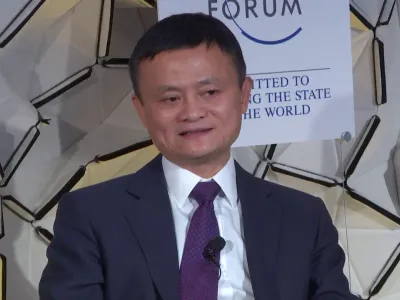
Davos 2019 - Meet the Leader with Alibaba Executive Chairman Jack Ma
On January 23, 2019, Jack Ma joined the World Economic Forum's Meet the Leader session in Davos, Switzerland, for a conversation with Global Shapers, Young Global Leaders, and Technology Pioneers. He discussed entrepreneurial fear and transparent communication, Alibaba's founding team, and his hiring criteria, as well as Africa's opportunity to leapfrog, education reform, climate and sustainable technology, empathy, job-hopping, regulation, and innovation in smaller countries. The later questions addressed friendship and founder privilege, coping with pressure, Alibaba's school experiments, learning from failure, entrepreneurship in the Middle East, Ma's personal goals, and China's responsibility as a global leader.
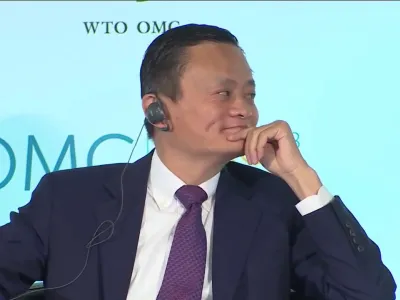
WTO Public Forum 2018: How Does Globalization Evolve with E-commerce?
On October 2, 2018, Jack Ma delivered a speech at the opening debate of the WTO Public Forum in Geneva, Switzerland. Against the backdrop of escalating US-China trade friction, he advocated reforming rather than abandoning the trade system, and improving rather than adding rules. He noted that new technologies bring both challenges and opportunities; in the next 30-40 years the internet will cover everything, 99% of trade will happen online, parcels will replace containers, and C2B will replace B2C. He argued that globalization's problems stem from its immaturity, and proposed three suggestions: first, reform — the WTO needs a 2.0 version and eWTP rules should be condensed to three pages; second, universal benefit — enabling developing countries, young people and women to participate in trade; third, cooperation — rules should be made jointly by governments, the private sector and stakeholders. He criticized the trade war as parents bickering over children, stressing that trade is not a weapon and that if there must be war, it should be against poverty, disease and pollution.
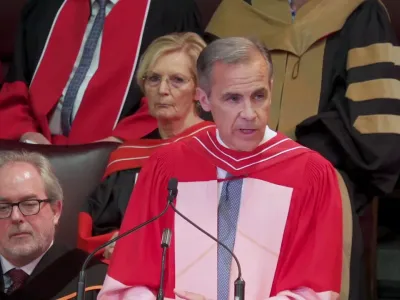
Mark Carney's 2018 Honorary Degree Address at University of Toronto: Purpose, Partnership and Perspective
On June 18, 2018, Bank of England Governor Mark Carney addressed honorary-degree graduates of the University of Toronto's Rotman School of Management. He warned that careers rarely follow straight lines and that detailed plans cannot control life's role for chance, urging graduates to remain flexible and adventurous and to treat each job as an investment in learning and adaptability. Amid shifts in global order, industrial technology, and social life, he offered three principles for leading organizations: define a purpose grounded in clients, society, and humanity; use partnership to turn diversity into inclusion; and maintain perspective through empathy and dialogue. Drawing on his own path from investment banking into central banking and the financial crisis, he argued that good fortune brings responsibility and encouraged graduates to stay true to their interests and values while creating the future they want.
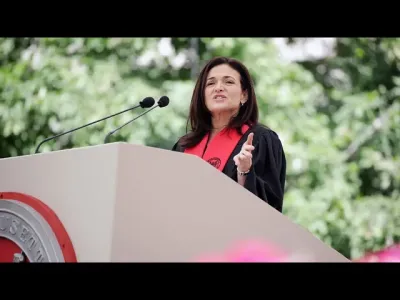
Sheryl Sandberg at MIT Commencement 2018
On June 8, 2018, Facebook chief operating officer Sheryl Sandberg addressed the MIT Class of 2018 at Commencement. She began with the uncertainty she felt at graduation and recalled learning, while working on a leprosy treatment program in India, that erasing social stigma mattered as much as providing medicine. Technology is made and used by people, she argued, so the industry must confront the hatred, misinformation, and harm its products can enable. Acknowledging that Facebook had failed to foresee and prevent all risks, she urged graduates to be clear-eyed optimists who advance technology while examining its ethical consequences. She called for more diverse teams, fair pay, family leave, and workplaces free of harassment, and asked graduates to use their influence to make technology serve everyone.
Launch of the AI Sector Deal
On 26 April 2018, UK Secretary of State for Digital, Culture, Media and Sport Matt Hancock spoke at Imperial College London at the launch of the AI Sector Deal. He described artificial intelligence as a compounding technological revolution and outlined joint investment by government, industry, and universities in skills, doctoral training, 5G and full-fibre networks, and public data. Hancock also argued that ethics and public trust had to be built into AI from the beginning. The address marked a major implementation step in the UK government's 2017 Industrial Strategy and illustrated its attempt to advance innovation, infrastructure, and ethical governance together.
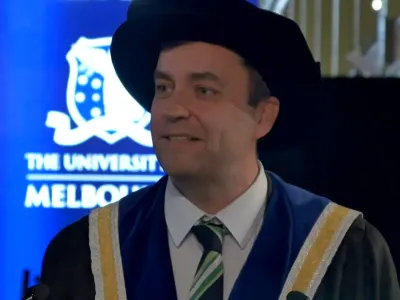
David Bowser's 2018 Graduation Address at the University of Melbourne
On April 10, 2018, University of Melbourne alumnus and Curio Group founder Dr David Bowser delivered an occasional address at a graduation ceremony in Melbourne's Royal Exhibition Building. Speaking to new doctoral graduates, he traced his own nonlinear path from medical research, a Cambridge fellowship, and an academic laboratory at Melbourne into management consulting and education entrepreneurship. Bowser argued that doctoral training develops valuable capabilities far beyond academia, including research and analysis, project management, communication, presentation, and group facilitation. His central advice was to understand one's strengths and interests, combine reflection with action, find a sense of purpose, and remember that graduates carry—and should give back to—their university's public mission.
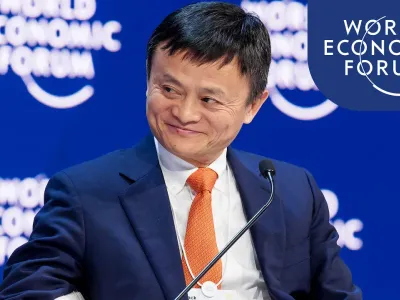
Davos 2018: Meet the Leader with Jack Ma
On January 24, 2018, Jack Ma spoke with Global Shapers at the 'Meet the Leader' session of the World Economic Forum in Davos, Switzerland. He argued that if the third industrial revolution triggers a world war, it should be humanity's war against disease, pollution, and poverty, not a war between people. He gave career advice by age group and used Alibaba's 49% female workforce as an example of women's empowerment, advocating inclusive globalization for SMEs and criticizing that the WTO struggles to reach consensus while businesspeople cooperate more easily. He also shared lessons from mistakes, investing 100 billion RMB in R&D, the Alipay decision inspired by a Davos leadership talk, education that cultivates values and soft skills, environmental disasters rooted in human greed, and finally talked about motivating employees and his own sleep habits.
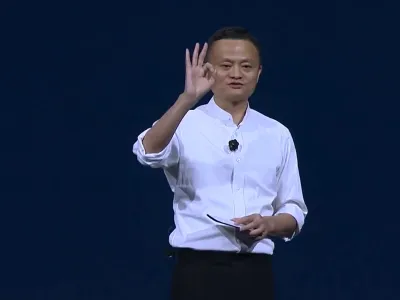
Gateway '17 Detroit Keynote: Rediscover China
On June 21, 2017, Jack Ma delivered a full English keynote speech at the Gateway '17 conference in Detroit, with over 3,000 small business owners and farmers from the US and Canada in attendance. He recalled his first 30 years of constant rejection: failing the college entrance exam three times, being rejected for police and KFC jobs, and turned down by 30 venture capitalists. He shared how Alibaba's 18 founders started with 15,000 US dollars, set up a company in San Francisco only to close it due to strategic mistakes, and offered five lessons for business survival: believe in the future, build the right team, focus on products as services, customers first, and entrepreneurs must stay focused. He urged American small businesses to rediscover China, arguing that in the next 30 years the Chinese market will fundamentally reshape the world economy, and China will shift from a major exporter to a major importer, offering huge opportunities for small businesses worldwide.

Tim Cook's MIT Commencement Address 2017
On June 9, 2017, Apple CEO Tim Cook addressed MIT graduates at Commencement. He recalled spending years searching for a purpose in school, work, and career advancement without finding a satisfying answer. Joining Apple under Steve Jobs finally gave him a mission: to serve humanity. Science and technology, he said, can improve health, education, and daily life, but may also bring threats to privacy and security, misinformation, and division. Drawing on his meeting with Pope Francis and Apple accessibility products, he urged graduates to bring humanistic values and empathy into technology. He closed by recounting how he defended environmental initiatives at a shareholders meeting and encouraged graduates to oppose injustice and use their minds, hands, and hearts to build something greater than themselves that serves everyone.
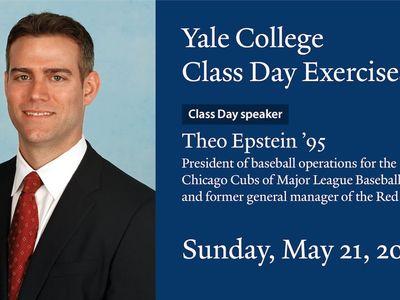
Theo Epstein's 2017 Class Day Address at Yale University: The Power of Choice
On May 21, 2017, Yale College alumnus Theo Epstein '95, then president of baseball operations for the Chicago Cubs, delivered the Senior Class Day address. The Cubs had just ended a 108-year World Series championship drought in 2016. Using the decisive Game Seven as his central story, Epstein described how the team responded after surrendering its lead and entering a rain delay: rather than retreating to separate lockers to complain or assign blame, the players chose to gather, support one another, and reconnect. He urged graduates to recognize their own future rain-delay moments and choose whether to keep their heads down protecting individual interests or lift their heads, connect with others, and put a team first. Epstein also reconsidered his early habit of treating players mainly as data and assets, arguing that character, empathy, trust, and human connection cannot be fully quantified. This edition follows the complete official transcript published by Yale University.
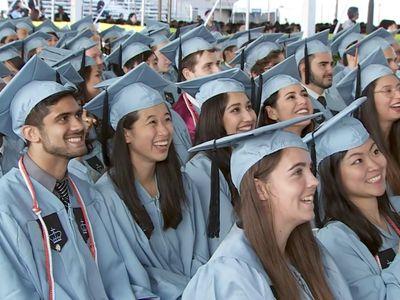
Kai-Fu Lee's 2017 Class Day Address at Columbia Engineering: An Engineer's Guide to the Artificial Intelligence Galaxy
On May 15, 2017, Columbia alumnus and Sinovation Ventures founder and CEO Kai-Fu Lee delivered the keynote address at the Engineering and Applied Science Class Day. Calling the coming decade the age of artificial intelligence, he explains how deep learning advances perception, prediction, decision-making, and automation, and predicts that finance, manufacturing, transportation, and other industries will be transformed while many repetitive jobs disappear. In response to the resulting growth in wealth, disruption of employment, and crisis of meaning, Lee offers graduates three pieces of advice: embrace the opportunities created by AI, accept engineers' responsibility for social consequences, and remain connected to the heart and to love. Drawing on his experience with stage IV lymphoma, he argues that brains and efficiency are not the whole of humanity; love, compassion, and care distinguish people from machines.
Rethinking Development Finance
World Bank Group President Jim Yong Kim delivered Rethinking Development Finance at the London School of Economics and Political Science on April 11, 2017. Confronting extreme poverty, fragile states, displacement, climate change, and the unequal distribution of globalisation's gains, he argues that development institutions must move beyond relying chiefly on public aid. Public resources should instead reduce risk and crowd in private capital while being combined with technical knowledge, institutional reform, and investment in human capital. Through examples from infrastructure, health, education, insurance, and clean energy, Kim explains how markets can be created for development. He closes with the aspirations of Tanzanian schoolchildren and challenges the development community to act at the speed and scale required to create genuine equality of opportunity.