Charlie Rose: When Alibaba completed the world's largest IPO, we all became much more aware of Jack and his story. I want to talk about his personal story—how many times he tried and failed, and what kept him going. I want to talk about where he is today, how he got here, where he is going, and how he expects to get there. If he gets there, what will it mean for him and for the people he wants to inspire? Let me begin with this question: Jack, why are you back at Davos?
Ma: Seven years is a long vacation. I remember the last time I came was 2008. Back then I came to Davos to attend the Young Global Leaders forum. I had never heard of Davos before. When I arrived in Switzerland, I saw many young people demonstrating. I asked, what are they doing? They said they were against globalization. I was puzzled — why would anyone oppose globalization? Globalization is such a good thing. Then on our two-hour drive we encountered many security checkpoints with machine guns. I thought, are we attending a forum or going to prison?
But after attending the Global Young Leaders forum at Davos, I heard many new ideas and got very excited. In my first few years I learned a lot — what globalization is, what corporate citizenship is, what social responsibility is. Many great things, many great leaders talking about what leadership is. I learned a lot and saw many young people discussing.
When the economic crisis hit in 2008, I thought it was best to go back to work, because you can never win the world by talking — you have to do it. So I went back to work for seven years. Now I've come back because I feel it's time to give something back. Having benefited from the forum back then, why shouldn't I share my story with more young leaders today and tell them what we've been through?
Rose: Alibaba is huge. So how big is Alibaba exactly now?
Ma: Every day over 100 million users visit our website. We've directly or indirectly created 14 million jobs. From 18 people in my apartment to 30,000 now, with an entire headquarters in Hangzhou. But I feel that compared to 15 years ago, Alibaba is huge, but compared to 15 years from now, today's Alibaba is still a baby.
Fifteen years ago we grew from nothing to today's scale. Fifteen years from now, I hope people won't see Alibaba, won't see Taobao, because they'll be everywhere. Everyone will treat Taobao as part of their daily life. I hope that in 15 years, people will forget about e-commerce — they'll feel it's like electricity, no one thinks of it as high-tech. I don't want us to still be walking down the street in 15 years talking about how e-commerce helps people.
Rose: Let's talk about the IPO. Did you see people's expectations?
Ma: Well, yes, it was a small IPO — $25 billion. I remember in 2001, I came to America to raise $3 million and was rejected by 30 VCs. So now I've come back asking for a bit more.
The more we think about the $25 billion raised, the more we think about how to spend it efficiently. This isn't money — it's trust from around the world. These people hope you can help more people better, and they want a better return.
This puts more pressure on me. When our market cap surpassed IBM, and maybe one day will surpass Walmart, we might be among the world's top 10 or 15 largest companies by market cap. I told my team, really? We're not that good. Years ago, people said Alibaba's business model was terrible, unprofitable, and full of problems—Amazon was better, eBay was better, Google was better. There was no such model in America.
I told my team, we're better than people think. Today I tell them we're not as good as people think. We're a 15-year-old young company with an average employee age of 27 or 28, doing something human beings have never tried before.
Rose: You were born in Hangzhou, founded your company in Hangzhou. Is your headquarters still there?
Ma: Yes. You build your roots where you start your business.
Rose: You were born in the 1960s, during the Cultural Revolution.
Ma: I was born in '64, the tail end of the Cultural Revolution. My grandfather was a small landlord, and after liberation he was considered a bad person. So as a child I knew how hard those times were.
Rose: You wanted to get into three universities, and each time they rejected you?
Ma: There was the college entrance exam, which I failed three times. I've failed a lot. I failed the key primary school entrance exam twice, and failed middle school entrance twice. It's hard to imagine — in Hangzhou, my primary school only existed for one year before being turned into a middle school, because our school's graduates were so bad no one wanted them, so we upgraded ourselves into a middle school.
Rose: How did it feel to be rejected?
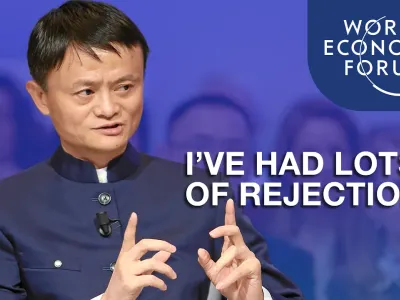
Ma: We have to learn to live with rejection. We're not that outstanding — even today many people still reject us. I remember applying for jobs 30 times and failing. I applied to the police — there were 5 applicants, 4 got in, only I didn't. When KFC came to China, 24 people applied, 23 were accepted, and the one who wasn't was me. I applied to Harvard 10 times and was rejected every time. I told myself, maybe one day I can go teach there.
Rose: Back then Nixon visited Hangzhou, and after that many tourists started coming to Hangzhou. Was that when you started learning English?
Ma: Yes, around age 12 or 13, for some reason I suddenly fell in love with English. Back then there was nowhere to learn it and there were no English books. So I went to the hotels in Hangzhou and, every morning for nine years, worked as a free tour guide. The visitors taught me English. This experience changed me. I'm completely made in China—I never received a single day of education abroad.
When people ask how I can speak English so well and sometimes think like a Westerner, I say those foreign tourists opened my mind. What they told me was very different from what I learned at school and from my parents. Those nine years taught me to think independently: whatever I see or read, I think about it for two minutes.
Rose: Was that when you became Jack Ma?
Ma: Jack was given to me by a lady from Tennessee. She came to Hangzhou for tourism, and we became pen pals. "Ma Yun" was too hard to pronounce. She asked, do you have an English name? She said, my husband and father are both named Jack — what do you think of Jack? I said, good. And I've used it ever since.
Rose: First time in America was 1995?
Ma: Yes, I was helping our local government build a highway.
Rose: You used the internet for the first time?
Ma: Yes, in Seattle, in the Bank of America tower. Inside the building, my friend had an office not even half the size of this room, with a computer. He said, Jack, try the internet. I said, what's the internet? He said, you can search for whatever you want. It was Mosaic back then, very slow. I said I don't want to touch it — the computer is too expensive, I don't want to break it, I can't afford to replace it. He said, just search.
I searched the first word: beer. I saw beer from America, beer from Japan, but no Chinese beer. I typed "China" — nothing, no data about China. So I said to my friend, why not create something Chinese? We made a small website for my translation agency.
I remember the site went live at 9:40. By 12 o'clock my friend said, someone sent you 5 emails. The emails said, where are you? This is the first time we've seen a Chinese internet website. How can we get in touch and do something together? I thought, this is interesting — we should do something.
Rose: Why the name Alibaba?
Ma: The internet belongs to the world, so we need a global name. Back then Yahoo was the best name. I thought for a long time about whether Alibaba was a good name. That day I happened to be in San Francisco. A waitress came over, and I asked her, do you know Alibaba? She said, sure — open sesame. I said great. I asked many other people, and they all knew Alibaba — Alibaba and the Forty Thieves, open sesame. I knew it was a great name. And since it starts with A, Alibaba is always first.
Rose: You said that to build Alibaba, you had to build trust, because Chinese people are used to face-to-face dealings. How did you build trust?
Ma: At the beginning, when we let people do business online, no one knew each other — how could you do business? You have to rely on trust. For e-commerce, the most important thing is trust. When I first went to America to raise money, many VCs said, Jack, it won't work — in China business relies on relationships, how could it work over the internet? I knew that without a trust mechanism, without credit, it would be impossible.
For the past 14 years, what we do every day is build a trust mechanism. Today I'm very proud. In China and the world today, people don't trust others — they always think others are cheating. But because of e-commerce, we complete 60 million transactions every day. We don't know each other, but we do business, deliver goods, send money. I don't know you, but I carry your package across oceans and mountains to deliver it to someone. At least 60 million acts of trust happen every day.
Rose: You initially used escrow to do this?
Ma: The escrow service came from Alipay, and that's why I love Davos — it was a big decision. In the early years, Alibaba was a big information platform, and people started discussing the lack of payment. I talked to banks, but no bank was willing to do it. What should I do? If I did payments, it might be illegal. But without it, e-commerce couldn't develop.
Then I came to Davos and attended a leadership forum. Leadership is about responsibility. After listening to that forum, I called my team and said, do it now, immediately. If anyone has to go to prison for this, let it be me, Jack Ma. Because building a trust system is too important for China and the world. But if you do it badly — stealing money, money laundering — then you go to prison. Someone told me back then, Alipay is your stupidest idea ever. But I said, as long as people use it — and now 600 million people use Alipay.
Rose: You never took money from the government?
Ma: If you're always thinking about getting money from the government, your company is poor and useless. If you think about getting money from the market and customers, then your company is successful. We also didn't take money from banks — back then I wanted it but they wouldn't give it; now they offer it but I don't want it.
Rose: Your relationship with the government? Some say that in China's environment, competition is restricted?
Ma: Our relationship with the government is interesting. I spent fourteen months working part-time for an organization under the Ministry of Foreign Trade and Economic Cooperation, and I learned that you should never rely on a government organization to do e-commerce. When I started the business, I told my team: fall in love with the government, but do not marry it. Respect it. When officials wanted to discuss the internet, censorship and other issues, I saw an opportunity and a responsibility to explain how the internet could help the economy and create jobs.
I'm grateful to all my investors. Back then many people thought Jack Ma was crazy—they did not understand what we were doing. Venture capitalists often funded Chinese copies of existing American models, but there was no American model like Alibaba. When I first appeared in Time magazine, they called me “Crazy Jack.” I think crazy is good. We are crazy, but not stupid; we know what we are doing. If everybody agreed with our idea, we would have no chance. I am thankful for the money we raised, and proud when our investors make a return.
Rose: In America there are big privacy issues — Google, Apple privacy issues. People ask whether the government should get data. If the government came to you and said they want the data...
Ma: So far, I haven't had this kind of trouble. If the Chinese government came to me regarding national security, terrorism, and fighting crime, we can cooperate. But for everything else — no. Data is too important. If it leaks, it's a disaster.
Many years ago, people said, I'd rather keep my money under my pillow than put it in a bank. But today everyone knows banks know how to keep money safer than you.
On privacy, we may not have a solution, but I believe in young people. In the next 20 years, there will be breakthroughs on privacy and security. I fully believe that.
Rose: Your life is living proof that "anything is possible." When someone says no, you say, "It's just getting started, don't rush." Where does this belief come from?
Ma: When I was young, I thought everything was possible. But now I know not everything can be done. You need to consider others more — customers, society, your employees, shareholders.
I'm always inspired by what we do. In our first three years, we made zero revenue, but we were excited because we were changing people's lives. Many times at a restaurant, when I tried to pay, the owner told me somebody else had paid the bill. A note would say: “Mr. Ma, I'm an Alibaba customer. I made a lot of money on your platform, and I know you don't make money, so I paid for your meal.”
I remember another time, I was in a cafe when someone walked over and handed me a cigar. I don't smoke cigars, but I saw a note on it saying, thank you, I'm your customer.
And another time, I was taking a taxi at the Shangri-La Hotel in Beijing. The doorman who opened the car door for me said, Jack, thank you very much — my girlfriend made a lot of money through your website.
So through these things, you understand your sense of mission. If you don't do these things, nothing is possible. If you start doing them, at least you have hope.
Rose: Now the revenue comes from advertising and transaction commissions?
Ma: Compared to the huge transaction volume, advertising revenue is small, and transaction commissions are small too. We rely on the masses. We now have 10 million SMEs on our platform, and our transaction volume is second only to Walmart. By taking a tiny cut from the transaction volume, we've become very large.
I remember five years ago, a senior Walmart executive came to Hangzhou and said to me, Jack, we know you've built a big business, well done. I said, maybe in ten years I'll surpass Walmart. He smiled and said, young man, you're ambitious. So we made a bet. Now I believe that in ten years, we will definitely surpass Walmart. If Walmart wants to add 10,000 new customers, it needs to build new warehouses and lots of supporting facilities. But for me, I just need two servers.
Now who has a higher market cap, us or Walmart? I don't know — I'd have to look it up.
Rose: For future development, what do you want now?
Ma: I want to talk about Alibaba's mission. We're an internet company that happened to be founded in China. We have the same entrepreneurial spirit as everyone else in the world. I always remember the mission when I founded Alibaba — to make it easy for SMEs to do business. Today, millions of SMEs use our platform to sell their products. Over 300 million consumers buy from our site. Our website is efficient and cheap.
So now I'm thinking: how do we turn Alibaba into a company that makes it easy to do business anywhere in the world?
My idea is, if we can let Norwegian merchants sell products to Argentina, and Argentine consumers buy Swiss goods online. So I want to create an organization — maybe not exactly, but it's called EWTO. The WTO was a great organization of the past century, with many large enterprises selling their products worldwide.
But today, the internet can help small businesses sell their products across continents and oceans, breaking national borders.
I hope to serve 2 billion consumers and 10 million small businesses outside the Chinese market.
Just like we helped a farmer in Washington State sell 300 tons of cherries to China. I remember the US ambassador said to me, Jack, can you help us sell American cherries? I said, why not? Let's try together.
Actually, before we started selling, these American cherries were still growing on trees on American farms.
So we did presales on our platform — 80,000 Chinese families pre-ordered the cherries. So within 48 hours of going on sale, the cherries went from the trees to these pre-ordering Chinese families. We sold out the cherries, and consumers were very happy. But three days later, we also received many complaint letters: why only 100 tons of cherries? Why can't you provide more?
Two months later, we brought in Costco and sold 300 tons of American nuts to Chinese consumers, and we also sold Alaskan seafood to China. So you see, if we can sell American seafood, cherries, and nuts to Chinese consumers, why can't we help more SMEs in America, Europe, and other countries sell their products to Chinese consumers?
Chinese consumers want these goods. So that's what I want to do. 2 billion consumers from Asia and developing countries — how do we make it easy for them to shop globally online?
Rose: Alibaba has witnessed hundreds of millions of Chinese people go from poverty to middle class. How is your international expansion? I know you're doing well in Russia.
Ma: We're doing well in the Brazilian and Russian markets. In Russia, we're the number two (or three) e-commerce platform. Last year we ran a marketing campaign in Russia. But you can't imagine — two years ago, a Russian order took four months from placement to delivery, yet many Russians were still happy to buy Chinese goods through our site. Last year, after a promotion, through our efforts we shortened that time to one week. But we paralyzed Russia's entire logistics system.
Rose: What are you planning to do in Hollywood?
Ma: I love Hollywood's innovation and digital technology. I've learned a lot from Hollywood movies, especially Forrest Gump. I love Forrest Gump's spirit — simple, never giving up. People thought he was stupid, but Forrest Gump knew what he was doing.
In 2002 or 2003, or even earlier, when I came to America, I was very inspired. Back then I couldn't find a path for e-commerce. At that moment I watched Forrest Gump and thought, he's the one we should learn from! Believe in what you're doing, whether people like it or not.
I love that line very much: "Life is like a box of chocolates, you never know what you're gonna get." Just like I never thought I'd be sitting here talking to Charlie Rose. But here I am. I said to the brothers who started the business with me in my apartment: brothers, we must work hard, not just for ourselves, but because if we succeed, 80% of Chinese young people will succeed.
Because we didn't have a rich father, powerful uncles, no money in the bank, no government connections — it was purely through the team's efforts that we succeeded.
Rose: What is your biggest worry?
Ma: I worry that many young people today lose their fighting spirit and enthusiasm, and start complaining. Because we went through the same thing — being rejected by so many people doesn't feel good. We were desperate back then, but we believed the world had many opportunities.
We also had those moments — being rejected so many times isn't a good feeling, we got depressed too. Then we discovered the world had more opportunities. We started looking at the world, learning how to succeed, how to seize opportunities. Hollywood also gave me a lot of inspiration.
Rose: But you want to do business in Hollywood?
Ma: We make movies to do business. We're an e-commerce company — many products need shipping, but movies and TV products don't need shipping, and movies are the best product to help young people.
In American hero movies, at the beginning the heroes look like bad guys. When bad things happen, they become heroes, and in the end they succeed and survive. In China, all heroes die — no one wants to be a hero anymore. We have so many heroes alive in this world.
Rose: Do you still read wuxia novels? Or have you started writing?
Ma: I read wuxia novels, and now I've started writing a bit.
When I'm busy or tired, I read kung fu books and find that as long as you work hard, have a good team and a good master, and practice hard, you can become an expert. So when I'm tired and busy, I'll read a wuxia book.
Rose: You practice tai chi, right?
Ma: I love tai chi. Tai chi is a philosophy — it's yin and yang, about how to maintain balance. When people ask about competing with eBay — do you hate eBay? I say no, no. eBay is a great company. He hits here, I hit there. You attack my upper body, I hit your lower body. He comes, I leave. I'm smaller than you, but I can jump — you can't.
Jack Ma: I use tai chi philosophy in business. Calm down; there is always a way out. Keep yourself balanced. Competition is fun, and business is not a battlefield where you die and I win. Even if you die, I may not win. Tai chi gives me a lot of inspiration.
Charlie Rose: You want your life and Alibaba to change the world, and you are changing it. You provide a marketplace and enable people to earn a living. You also believe Alibaba should change the lives of women. What are you doing?
Jack Ma: Many years ago, I wanted to change the world. Now I think that if we want to change the world, we should change ourselves. Changing ourselves is more important and easier. I want to improve the world; changing the world may be President Obama's job. My job is to make sure my team is happy, because a happy team can make our customers happy. Our customers are small businesses, and when they are happy, we are happy. One secret of Alibaba's success is that we have a lot of women.
Charlie Rose: What percentage of your employees are women?
Jack Ma: Two or three months before our IPO, an American journalist came to our company. She asked, “Jack, why are there so many women in your company?” I said, “What's wrong?” We later found that 47 percent of our employees were women. It had once been 51 percent, but the companies we acquired had more men.
Charlie Rose: Are women also in senior positions?
Jack Ma: Thirty-three percent of management and 24 percent of senior management are women. We have women serving as CEO, CFO and CPO—chief people officer. I feel comfortable working with them. To win in the twenty-first century, you must empower other people and make them better than you. Women think about others more than they think about themselves. They think about their children, husbands and parents, and they understand user-friendliness.
Charlie Rose: Before we finish, are you worried about China now that its economy has slowed?
Jack Ma: No. Slower growth is much better than continuing at nine percent. China is already the world's second-largest economy; it cannot keep growing at nine percent. If it did, something would be wrong: we would never see blue skies or quality growth. China should focus on the quality of its economy. Like a human body, it cannot keep growing in size forever. At a certain point physical growth slows, but the mind, culture, values and vision should continue to grow. China is moving in that direction.
Charlie Rose: Have you met Prime Minister Modi in India?
Jack Ma: Not yet. I am looking forward to it.
Charlie Rose: Finally, you are one of the world's richest people and Alibaba is one of the world's richest companies. What do you want beyond Alibaba?
Jack Ma: I was not happy when people called me the richest person in China. Fifteen years ago, my wife was one of the eighteen founders in my apartment. I asked her, “Do you want your husband to be rich, or to be respected?” She said respected, because neither of us believed we would become rich; we only wanted to survive.
Jack Ma: When you have one million dollars, that is your money. When you have twenty million, you start worrying about inflation and which stocks to buy. When you have one billion dollars, it is not your money. It is the trust society has given you because people believe you can manage and use it better than others. Today I have resources and influence, so I should do more and spend more time with young people. Someday I will return to teaching and share what I have learned. The money is not mine; I am fortunate to have these resources and want to do a better job with them.
Charlie Rose: Tell young people your story.
Jack Ma: I do not think many people have been rejected more than thirty times. The important thing is never to give up. Like Forrest Gump, we keep fighting, keep changing ourselves and do not complain. When people fail and always complain about others, they will not come back. If they examine themselves and ask what they did wrong, they still have hope.
Charlie Rose: Jack, on behalf of everyone here and the television audience around the world, thank you for taking the time to be with us.
Jack Ma: Thank you.