Aravind Srinivas's 2025 Winter Commencement Address at UC Berkeley: Relentless Curiosity
On December 20, 2025, Perplexity co-founder and CEO and UC Berkeley alumnus Aravind Srinivas addressed Berkeley's winter commencement. Rather than predict how artificial intelligence would reshape society and work, he organized his advice around three questions: “Who cares what you do next?”, “What are you waiting for?”, and “What's with all these questions?” He used velocity, compounding, and pain tolerance to explain growth, urging graduates to act quickly, keep learning, wait patiently for long-term results, and remain consistent through setbacks. The address culminated in a call for relentless curiosity. Education, he argued, is not chiefly about accumulating correct answers but about developing the spirit of inquiry. The defining ability for the future will be asking better questions, seeking truth, and using curiosity to create a world that does not yet exist.

Iman Chaudhry's 2025 Graduation Address at UCL
Published by University College London's media platform on September 23, 2025, this student address was delivered by Global Humanitarian Studies graduate Iman Chaudhry at the Faculty of Mathematical and Physical Sciences summer graduation ceremony. Chaudhry invited graduates to pause amid the celebration and honour the past selves whose work, sleepless nights, deadlines, personal challenges, and quiet courage had brought them to the day. She argued that resilience may never appear on an academic transcript, yet can be among the most valuable things students carry forward. Looking toward a future that may feel clear to some and uncertain to others, she encouraged her classmates to transform fear into excitement one day at a time, meet challenges with courage, and let knowledge guide them while humanity anchors them. The world, she concluded, needs both scientific solutions and compassionate care.
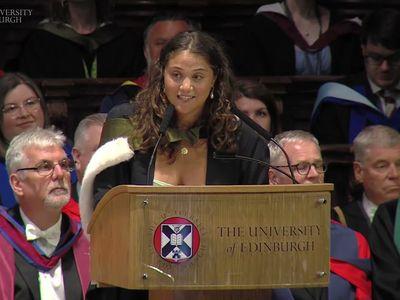
Abigail Morton's 2025 Graduation Address at the University of Edinburgh: A Message to My Fellow Graduates
Published by the University of Edinburgh on July 15, 2025, this student oration was delivered by Biomedical Sciences graduate Abigail Morton at the summer graduation ceremony in McEwan Hall. Morton used shared memories of Edinburgh's wind, fog, freezing morning classes, online examinations, laboratories, flashcards, and statistical code to reflect on four years of growth from strangers into a mutually supportive community. She thanked families, friends, and mentors who continued to believe in students during moments of self-doubt and argued that university had developed not only knowledge but critical thinking, research skills, resilience, empathy, and purpose. Whether graduates moved into research, medicine, technology, education, policy, or a well-earned pause, she encouraged them to proceed with courage, curiosity, confidence, and open minds—asking large questions while being willing not always to have the answers.
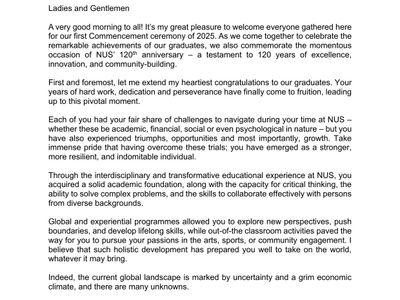
Tan Eng Chye's 2025 Commencement Address at NUS
On July 10, 2025, National University of Singapore President Tan Eng Chye addressed graduates as NUS marked its 120th anniversary. He reflected on the academic, financial, social, and psychological challenges students had navigated and the growth they achieved. Interdisciplinary education, critical thinking, complex problem-solving, collaboration across backgrounds, global experience, and extracurricular pursuits had prepared them for change. Facing an uncertain world and a grim economic climate, Tan argued that life does not require a perfect plan, but a strong sense of purpose can provide clarity and fortitude through unexpected turns. Quoting Chadwick Boseman on purpose, he encouraged graduates to preserve hope, adopt a growth mindset, and commit to continuous learning. Recalling that NUS was founded by and for the community in 1905, he invited graduates to join a legacy of dreamers, changemakers, and trailblazers serving country and society.
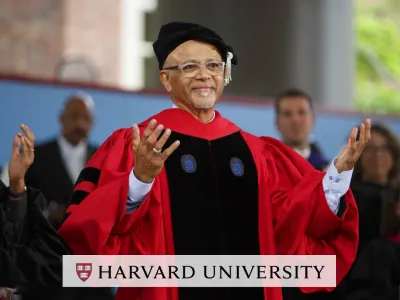
Abraham Verghese's 2025 Harvard Commencement Address: Finding Our Shared Humanity
Physician, author, and Stanford professor Abraham Verghese delivered this address at Harvard on May 29, 2025. Drawing on medical training, migration, and literary work, he considers what human capacities matter as artificial intelligence advances rapidly. Verghese recognizes the power of machines in computation, diagnosis, and knowledge processing but warns against surrendering attention, touch, story, empathy, and the rituals of human encounter to technology. Education, he argues, transmits more than information: it forms judgment, character, and the imagination needed to enter another person's experience. In uncertain times, graduates should remain curious, see the people around them fully, use expertise in service of community, and protect forms of human connection that efficiency cannot replace.
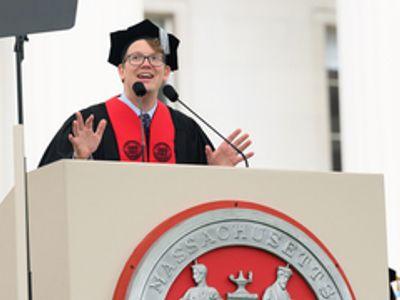
Hank Green Address to MIT Class of 2025
On May 29, 2025, science communicator, author, and video creator Hank Green addressed the graduating Class of 2025 at MIT. He opened with unusual facts about bones and shared answers to a survey of graduates: they had built all kinds of things at MIT, while friends, family, and other people gave them hope. Green discussed challenges facing speech, science, education, climate, and emerging technologies. He urged graduates to stay curious and notice solvable everyday problems that ordinary people face but society often overlooks. He warned that social platforms and incentives to make money can steer attention, and encouraged graduates to choose consciously what to care about and whom to build for. He advised them to try ideas in the real world, make room for joy in an imperfect world, and remember that value and meaning come from people. He closed by urging them to build themselves as well as tools, and to act for others and for a beautiful, bizarre world.
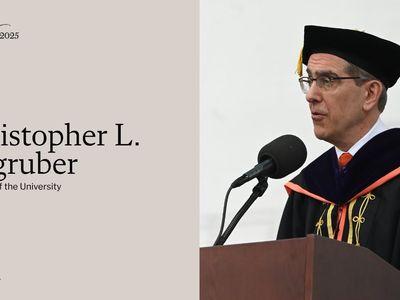
Christopher L. Eisgruber's 2025 Commencement Address at Princeton University: A Fierce Independence of Mind
On 27 May 2025, Princeton President Christopher L. Eisgruber delivered the Commencement address 'A Fierce Independence of Mind' to the Class of 2025. He began from the blur of his own graduation, a Samsonite briefcase, and a copy of Tocqueville's Democracy in America, recalling how the nineteenth-century Frenchman, despite magnificent insights, never foresaw the rise of American research universities, having declared that Americans had no literature properly speaking and few devoted to abstract knowledge. Eisgruber used this to show that the creativity universities cultivate, the idiosyncrasies they tolerate, and the speculative research they cherish can put them at odds with the pragmatic culture around them and jeopardize academic freedom. He criticized the double meaning in 'institutional neutrality,' and, citing the Kalven Committee's invocation of Socrates, insisted that a good university, like Socrates, should be upsetting. He urged graduates to cultivate a fierce independence of mind, with the courage to ask questions that are unsettling to the world and to themselves.
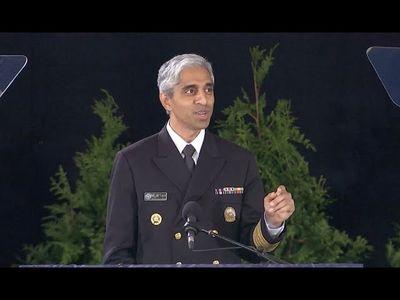
Vivek Murthy's 2024 Class Day Address at Yale University: Love and Connection
On May 19, 2024, U.S. Surgeon General and Yale medical and management alumnus Vivek Murthy delivered Yale College’s Class Day address. Speaking to a graduating class whose college experience began during the pandemic, he described strong relationships as essential to health, happiness, and humanity. Through three personal stories, Murthy offered a practical framework for connection: be present, be real, and show up when others need help. He discussed the health consequences of loneliness and recalled how friendship helped him and his family through periods of loss and uncertainty. He concluded by guiding graduates to feel the support of family, friends, and mentors, calling love the world’s oldest medicine and the ability to give and receive it our greatest gift and power. The text follows publisher-provided manual English captions on Yale University’s official video.
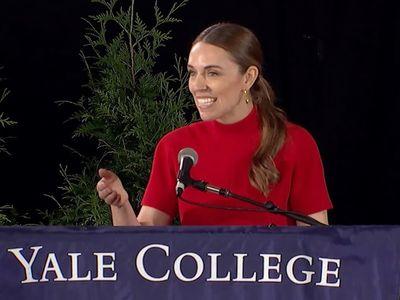
Jacinda Ardern's 2025 Class Day Address at Yale University: Empathy and Responsibility
On May 18, 2025, former New Zealand Prime Minister Jacinda Ardern delivered Yale College’s Class Day address. Beginning with a Māori greeting and a proverb about education, she reflected on her unexpected path into political leadership and on confronting M. bovis, the COVID-19 pandemic, and the Christchurch terrorist attack. Ardern argued that self-doubt can produce humility and that sensitivity can become empathy and action. Turning to war, climate change, disinformation, trade conflict, and declining respect for human rights, she maintained that domestic interests and global responsibility are linked rather than competing choices. She urged graduates to lead with shared values, a rules-based order, empathy, and responsibility because the present moment is about each person and about everyone connected to them. The text follows publisher-provided manual English captions on Yale University’s official video.
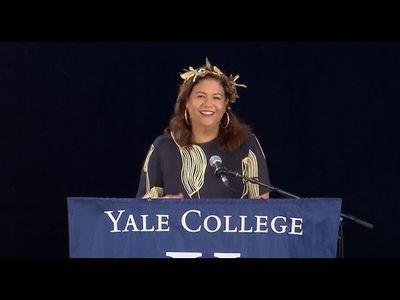
Elizabeth Alexander's 2023 Class Day Address at Yale University: Freedom for Everyone
On May 21, 2023, poet, scholar, cultural advocate, and Mellon Foundation president Elizabeth Alexander delivered Yale College's Class Day address. Speaking as a member of the Class of 1984, a former Yale professor, a Yale mother, and a longtime New Haven resident, she recounted how a proposed Black college was rejected in New Haven in 1831 and used that history to examine education, historical memory, and freedom. She connected the story to book bans, public monuments, and prison libraries, arguing that people become educated for others as well as themselves. Alexander urged graduates to keep reading, speak courageously, bring absent voices into the room, and help make the dream of freedom real for everyone. The text follows publisher-provided manual English captions on Yale University's official video.
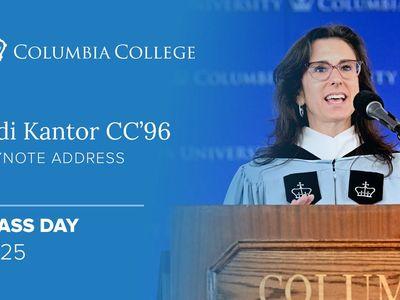
Jodi Kantor's 2025 Class Day Keynote Address at Columbia College: Be the Author of Your Own Life
On May 20, 2025, Pulitzer Prize-winning New York Times investigative reporter Jodi Kantor delivered the Columbia College Class Day keynote. Addressing graduates shaped by campus conflict, a contracting job market, artificial intelligence, and uncertainty for international students, she begins with a confession: as an undergraduate she was removed from the student newspaper, and she later left Harvard Law School. These experiences show that the chaos and humiliation of youth do not determine the future. Kantor advises graduates to notice which daily tasks genuinely engage them, to leave trains heading in the wrong direction, and to organize career choices around two ideas: social need and personal craft. Drawing on the investigation of Harvey Weinstein, she emphasizes technique, strict professional standards, and the ability to confront power. She closes by urging students to become authors of their own lives and asking alumni to provide guidance and opportunities.
Ryu Honglim's 2025 Congratulatory Address at SNU's 79th Winter Graduation Ceremony
On February 26, 2025, Seoul National University President Ryu Honglim addressed the 79th Winter Graduation Ceremony. He began by recognizing a class whose university memories were shaped by COVID-19, virtual classes and research, and reduced face-to-face contact, praising the wisdom and strength gained by making it through that long tunnel. He then focused on two virtues. Courage, he argued, is not recklessness but the capacity to analyze conditions, choose decisively, and maturely accept the consequences. The second virtue is living together: individual accomplishment depends on others and shines most fully when aligned with the universal values of a community. Ryu urged graduates to meet uncertainty with courageous intellect and a conscience directed toward the common good, moving forward alongside others as SNU alumni. He also marked fifty years since the university's Gwanak campus integration and invited alumni to participate in SNU's coming educational and research transformation.