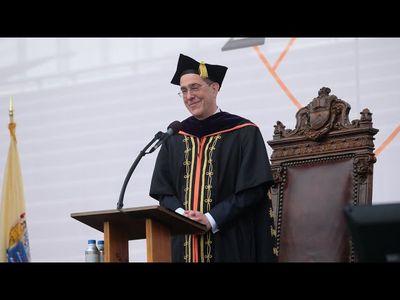
Christopher L. Eisgruber's 2021 Commencement Address at Princeton University: Together, Six Feet Apart
On May 16, 2021, Princeton University President Christopher L. Eisgruber delivered the Commencement address 'Together, Six Feet Apart.' Addressing graduates who had persevered through quarantine and remote learning, he used the metaphor of being together yet apart to capture the past year: people connected in a virtual world through technology yet lost their real, three-dimensional togetherness. Invoking Aristotle's insight that people must break bread together to forge a common good, he observed that while technology has transformed human connection, the pandemic made clear that to forge a common good we must genuinely be present to one another. He urged graduates, as they venture forth, to restore and rebuild the real human connection and community so urgently needed. The text follows Princeton University's complete official remarks published as prepared.
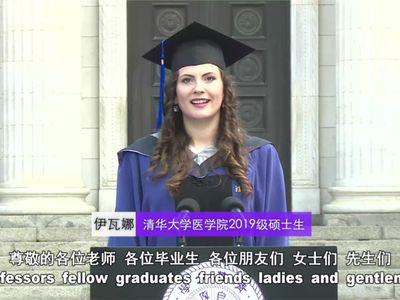
Actions Speak Louder Than Words — Ivana Todorovic's Speech at Tsinghua University (2020)
On June 22, 2020, Ivana Todorovic, a master's graduate of Tsinghua University's School of Medicine, spoke on behalf of the graduating class at an exceptional commencement shaped by the COVID-19 pandemic. She recalled being born during wartime, living as a refugee in Serbia, and being raised by a single mother whose lesson—complain less and find a solution at any cost—became a guiding principle. Drawing on her experience of remaining on campus, following public-health measures, continuing her studies online, and organizing donations of protective equipment to Bosnia, Todorovic emphasized personal action, collective cooperation, and international solidarity. She urged fellow graduates to meet new challenges in the spirit of Tsinghua's maxim that actions speak louder than words, and to work together for a better and more prosperous world.
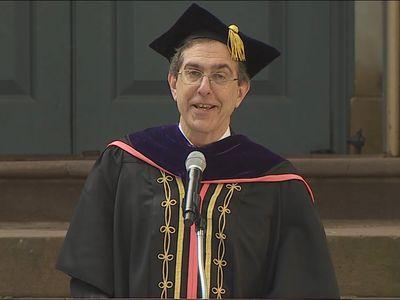
Christopher L. Eisgruber's 2020 Commencement Address at Princeton University: Touched by Tragedy
On May 31, 2020, Princeton President Christopher L. Eisgruber delivered Touched by Tragedy for the University's virtual Commencement. He recalled quoting Holmes's account of wartime experience at his own graduation without fully understanding its hardship, then turned to the losses confronting graduates during the pandemic and the fragility of the world. Acknowledging that those losses were real and painful, he encouraged students to develop insight, courage, and compassion and cooperate for the common good. This text includes only the named commencement address published by Princeton that day. The page also carries a separate statement on George Floyd's death and racism; the two works have not been combined.
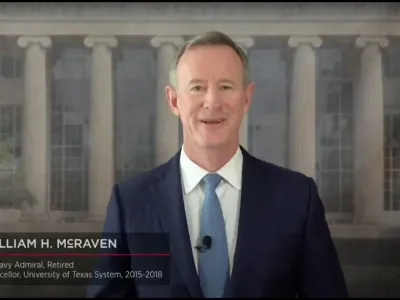
Admiral William H. McRaven at MIT Commencement 2020
On May 29, 2020, MIT held its Commencement online. Retired U.S. Navy four-star admiral and former University of Texas System chancellor William H. McRaven addressed the Class of 2020. Because the pandemic kept graduates from gathering on campus, he rewrote his planned speech to discuss the heroes the world actually needs. He told graduates that the challenges of pandemics, war, climate change, poverty, racism, and extremism call on people with knowledge and technology to act, but intellect and talent alone are insufficient. Drawing on military experience and the history of science, he said heroes also need courage, humility, perseverance, sacrifice, integrity, and compassion, citing figures such as Copernicus, Marie Curie, and Jim Allison. He closed by hoping that the Class of 2020 would be the last to miss an in-person Commencement because of a crisis and urging them to become the heroes the world needs.

Jean Bennett's 2020 Class Day Address at Yale University: Making the Impossible Possible
On May 17, 2020, Yale College alumna and ocular gene therapy pioneer Jean Bennett '76 addressed a virtual Class Day held during the COVID-19 pandemic. Using 20/20 as both the graduating year and a symbol of clear vision, she recalled growing up in New Haven, entering Yale among its early women undergraduates, and moving from molecular biology into medicine and retinal gene therapy. Bennett described how her team restored sight in animals born blind and then persisted through a field-wide shutdown after a gene therapy patient died, overcoming funding, regulatory, and clinical-trial barriers until Luxturna received approval. When the pandemic closed her laboratory, she pivoted toward vaccine research and urged graduates to treat disruption as an opportunity to redesign the world through science, public service, art, and care for one another. The text follows publisher-provided manual English captions on Yale University's official video.
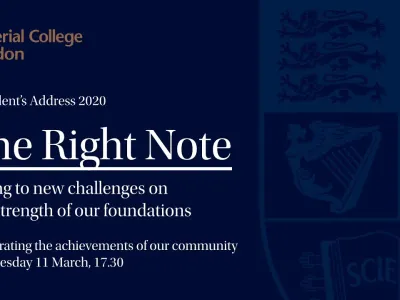
The Right Note
On 11 March 2020, Imperial College London President Alice Gast delivered her annual address, The Right Note, as COVID-19 was spreading rapidly. Using the jazz improvisation of Miles Davis and Wynton Marsalis as a sustained metaphor, she argued that excellence grows from strong foundations, trusted collaboration, and risk-taking. The speech stressed facts, knowledge, and rational judgment against pandemic misinformation, while also addressing community engagement, UK research investment, regional and international partnership, Horizon Europe, and bold innovation. Gast closed by comparing the university to a jazz ensemble and urging Imperial to rely on shared values, collaboration, and courage to find the right note in uncertain times.
Facing the Future: How Universities Respond to the Climate and Democratic Crises
On 1 October 2019, University of Cambridge Vice-Chancellor Stephen J. Toope delivered his annual address in Senate House. This edition uses the complete official text published in the Cambridge University Reporter. Toope reviewed achievements in research, campus development, digital education, sport, and European collaboration, then discussed Brexit uncertainty, higher-education regulation, fair access, student support, staff progression, pay and pensions, and disciplinary reform. He defended lawful free expression while rejecting its use as cover for hatred or unlawful conduct. Looking ahead, he proposed an interdisciplinary Programme of Action addressing mental health, democracy, and social inequality, and announced Cambridge Zero, intended to mobilize research, education, and University operations for a zero-carbon transition. Describing Cambridge as a global village connecting human-scale communities with worldwide purpose, he argued that a public university must step forward in uncertain times and pursue excellence through openness, diversity, and public spirit.
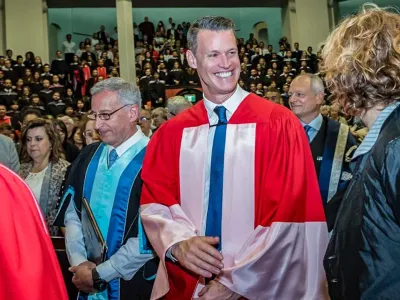
Mark Tewksbury's 2019 Honorary Degree Address at University of Toronto: Embrace Contradictions, Show Conviction, Embody Values
On June 25, 2019, Canadian Olympic swimming champion and LGBTQ equality advocate Mark Tewksbury delivered a University of Toronto honorary-degree address. He offered three principles: embrace contradiction, adapting between speaking and listening without abandoning values; show conviction, allowing passion to drive innovation after career setbacks; and embody values by knowing what one stands for and acting accordingly. He described discarding a rallying speech after a Georgian luger died before the Vancouver Winter Olympics and using honest humour to comfort Team Canada, illustrating why one should never say never. He also traced his journey from losing a world title by six hundredths of a second to changing his training and winning Olympic gold in Barcelona by the same margin. Finally, he recalled how coming out enabled him to advocate at the United Nations and support young athletes, arguing that Pride is fundamentally about belonging for everyone.
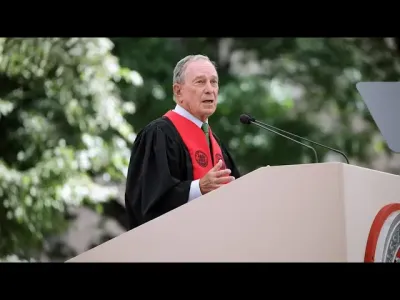
Michael Bloomberg MIT Commencement Address 2019
On June 7, 2019, entrepreneur, philanthropist, and former New York City mayor Michael Bloomberg addressed the MIT Class of 2019 in Killian Court. Beginning with Apollo 11 and the navigation system designed at MIT, he compared confronting climate change to a moonshot for the graduating generation. He argued that many necessary clean energy technologies already existed and that inadequate political action was the most urgent obstacle. In the speech he announced a $500 million commitment through Bloomberg Philanthropies to launch Beyond Carbon, an initiative to retire coal plants, halt new gas plants, support state and local policies, and engage in elections. He urged graduates to use their ingenuity, voices, and votes to move the United States toward a clean energy future.
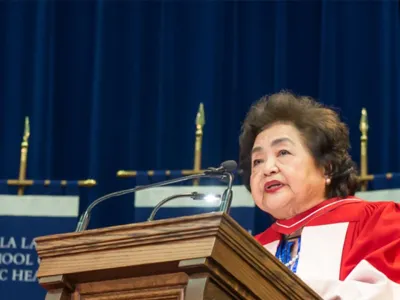
Setsuko Thurlow's 2019 Honorary Degree Address at University of Toronto: Unshakable Visionary Love
On June 5, 2019, Hiroshima atomic-bomb survivor, social worker, and nuclear-disarmament activist Setsuko Thurlow received an honorary degree from her alma mater, the University of Toronto. She recalled surviving the bombing as a teenager, choosing social work after witnessing mutual aid amid devastation, and how the hibakusha turned personal trauma into a responsibility to warn the world about nuclear weapons' inhumanity and immorality. She described U of T's teaching on the right to life, individual dignity, and practical fieldwork as the foundation of her activism. The address also traced the adoption of the Treaty on the Prohibition of Nuclear Weapons by 122 nations and the Nobel Peace Prize awarded to the International Campaign to Abolish Nuclear Weapons. She offered graduates four lessons: think beyond themselves, take action, persist and persevere, and trust unshakable visionary love as the power capable of overcoming the world's problems.
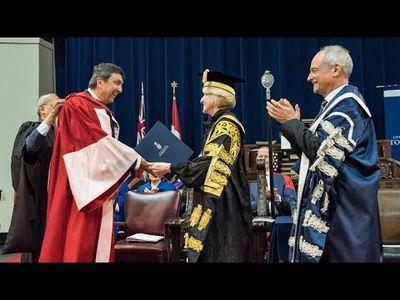
David Naylor's 2019 Honorary Degree Address at University of Toronto: The Future of Health Care
On June 4, 2019, physician, health researcher, and former University of Toronto president David Naylor addressed the Faculty of Medicine's honorary-degree convocation. Comparing health care at his 1978 graduation with medicine transformed by genomics, stem cells, gene editing, and artificial intelligence, he argued that the field was moving from poking, prodding, plumbing, and palliation toward predictive, pre-emptive, personalized, and participatory care. He warned that the digital deluge also carries anti-vaccine misinformation and that new technologies will raise ethical, legal, access, and affordability problems without replacing public health or the social determinants of illness. He closed with five recommendations: champion health research, advocate fair and safe system reform, keep learning, treat patients with empathy rather than as digital cases, and recognize health care as a team sport. Graduates' most precious asset, he said, is time and its boundless possibility for positive change.
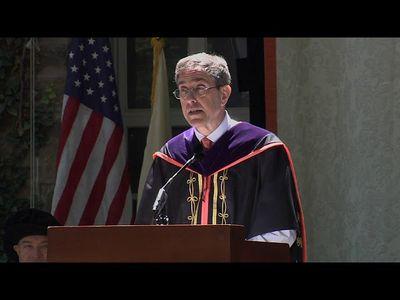
Civil Virtues
On June 4, 2019, Christopher L. Eisgruber, President of Princeton University, delivered the commencement address "Civil Virtues." Confronting an angry, accusatory political culture, he cited the Covington Catholic High School students' encounter at the Lincoln Memorial to show how the internet amplifies hostility and lets unproven accusations wound. Eisgruber focused on grounds for hope: most people still aspire to treat others decently. He reminded graduates that civic norms are fraying and that quiet, everyday virtues such as civility, truthfulness, due process, and moderation are the indispensable foundation of democratic society. He urged graduates to live and bravely defend these civil virtues. The text follows Princeton University's complete official remarks published as prepared.