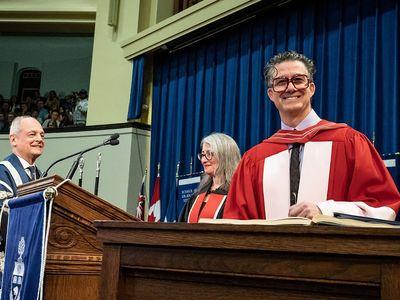
Derrick Rossi's 2023 Honorary Degree Address at University of Toronto: Choose the Road Less Travelled and Make an Impact
On June 9, 2023, stem-cell biologist and Moderna co-founder Derrick Rossi addressed an honorary-degree convocation for University of Toronto public-health and social-work graduates. Drawing on a path from Scarborough through solo travel in Africa, hitchhiking across Europe, and repeated changes of country and doctoral program, he urged graduates to choose the road less travelled—or forge a path where none exists—to enrich life and build resilience for the unknown. His second theme was impact. At Stanford he saw how laboratory discoveries could become companies and therapies, then at Harvard used messenger RNA to alter cell fate and developed technology that helped launch Moderna. The pandemic allowed that platform to help patients on a scale he had never expected and led him to abandon the idea of retiring after one successful contribution. He now regards making a positive impact throughout life as a continuing duty.
Hugh Brady's 2022 Inaugural President's Address at Imperial College London
On 11 October 2022, Hugh Brady delivered his inaugural annual address as President of Imperial College London. He thanked the community for its research, teaching, and mutual support during COVID-19, then traced his path from clinical medicine and kidney research to university leadership. Brady described Imperial's distinctive combination of science, engineering, medicine, business, entrepreneurship, and its London location, and announced a College-wide refresh of its vision and strategy. Alongside immediate concerns such as mental health, culture, workload, and student hardship, he set out longer-term questions about scaling research and innovation, advancing diversity, developing the White City Campus, achieving net zero, and strengthening Imperial's international presence.
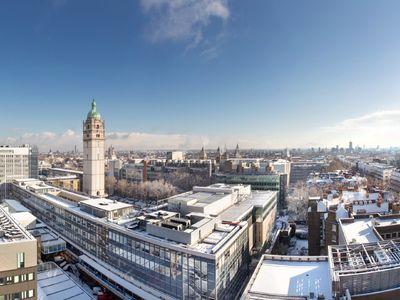
Acting Courageously
On 20 July 2022, Alice Gast delivered her eighth and final annual President's Address at Imperial College London's South Kensington Campus. Beginning with her 1980 valedictory speech at the University of Southern California, she connected youthful fears of war, economic crisis, and energy shortages with contemporary uncertainty. The address reviewed the Imperial community's courage during COVID-19 and reflected on caring for local communities, advancing diversity and belonging, supporting discovery and women entrepreneurs, defending international collaboration, and widening public engagement. Gast presented education as a force that gives people confidence and courage, then used the idea of camouflaged moments to look back on her tenure and urged staff and students to remain strong and keep acting courageously.
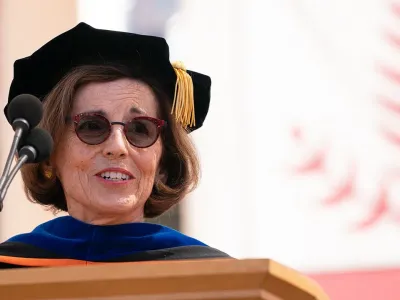
France A. Córdova's 2022 Stanford Commencement Address: Real Life Is Right in Front of You
On 2022-06-11, France A. Córdova delivered this address at Stanford University's Commencement. Organized around curiosity, interdisciplinarity, and entering the unknown, it joins personal experience, professional judgment, and the public concerns of its moment. The address asks not only what graduates might do next, but also how educated people should understand their abilities, accept public responsibility, and help build a shared future. This edition is based on a complete authoritative transcript and preserves the sequence and character of the original address.
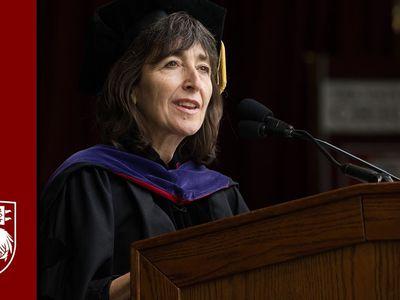
Wendy Freedman's 2022 Convocation Address at the University of Chicago: Our Evolving Universe
On June 4, 2022, astronomer Wendy Freedman delivered a University of Chicago convocation address titled "Our Evolving Universe." Beginning with the birth of the universe and the stars that forged the elements of life, she placed humanity within a visible cosmos 93 billion light-years across before returning to an Earth marked by pandemic, war, violence, and climate crisis. She used COVID-19 vaccines, the James Webb Space Telescope, and the Giant Magellan Telescope to show how global, cross-institutional cooperation can produce extraordinary progress in dark times. Drawing on Copernicus, Galileo, and her own experience challenging an astronomical authority, Freedman urged graduates to resist static worldviews, keep testing their assumptions, meet change with openness and courage, and build a lifelong "personal graduate school" of their own.
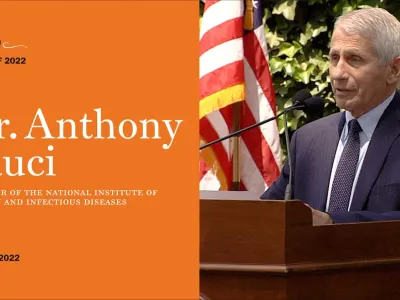
Anthony S. Fauci's 2022 Class Day Address at Princeton University: Leadership by Example
On May 23, 2022, Anthony S. Fauci, then director of the National Institute of Allergy and Infectious Diseases, addressed Princeton University's Class Day. It was the first in-person Class Day in three years, following profound disruptions to students' education and lives during the pandemic. Fauci recognized their adaptability and resilience and recalled his decision to redirect his research toward AIDS, encouraging openness to unexpected opportunities. He also discussed health inequities exposed by the pandemic, public service, leadership responsibilities, and national division. He urged graduates to use critical thinking to defend facts and integrity while cultivating joy in their lives. This text follows the complete prepared remarks published by the university and may differ from the spoken delivery.
Randy Schekman's 2022 Commencement Address at UC Berkeley: We Win If Your Mind Is Stretched, but Not Filled
On May 14, 2022, Nobel laureate and UC Berkeley professor Randy Schekman delivered the keynote address at Berkeley's campuswide commencement. With humor, he asked what a university education should leave behind once memorized facts fade: not a mind filled with information, but one stretched by critical inquiry, evidence, and curiosity. He illustrated perseverance and the value of public education through the story of mRNA vaccine pioneer Katalin Karikó, whose path from poverty and emigration through academic rejection ultimately helped save millions of lives. Schekman then connected scientific freedom and discovery to public investment, immigration, and the historic accessibility of the University of California. He urged graduates to defend public higher education as an engine of social mobility so future generations can enjoy the same outstanding opportunities.
Se-Jung Oh's 2022 Congratulatory Address at SNU's 76th Winter Graduation Ceremony
On February 25, 2022, Seoul National University President Se-Jung Oh delivered a virtual address for the 76th Winter Graduation Ceremony from the university gymnasium. Congratulating graduates unable to attend because of COVID-19, he thanked families, faculty, and alumni for making their achievements possible. Against the pandemic, climate change, international tension, domestic conflict, and a difficult socioeconomic outlook, Oh described three responses to adversity: being defeated, merely enduring and returning to the starting point, or discovering a breakthrough and leaping forward. He urged graduates to choose the third path and find new possibilities within trials. Oh also reminded them that personal accomplishment rests on support from family, teachers, and society. A country can have abundant talent yet still fail if experts and intellectuals lack a spirit of public duty. He asked SNU graduates to carry that duty beyond Gwanak Campus and to sail forward with the university as an anchor of the heart.
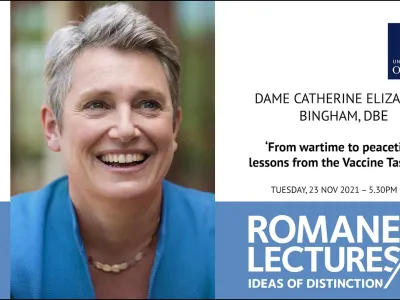
From Wartime to Peacetime: Lessons from the Vaccine Taskforce
On 23 November 2021, biotechnology investor and former UK Vaccine Task Force chair Kate Bingham delivered the Romanes Lecture at the Sheldonian Theatre, University of Oxford. She explained how the task force applied a venture-capital mindset to select vaccine candidates, funded manufacturing capacity in advance, used the National Health Service to accelerate clinical trials, and combined rapid authority with cross-government collaboration to support vaccine deployment. Bingham also criticized Whitehall's shortage of scientific and industrial expertise, a procedural culture averse to risk, and distrust between government and bioscience companies. She called for scientific cases to be embedded in policy, for civil-service recruitment, development, and incentives to be reformed, and for a permanent pandemic-security leader to convert wartime innovation into peacetime institutional resilience.
Thomas F. Hofmann's 2021 First Years' Convocation Address at the Technical University of Munich
On October 18, 2021, Technical University of Munich President Thomas F. Hofmann delivered this English-language address at the first-years' convocation on the Garching campus. More than 14,000 new students were returning to campus after a long period of online learning, remote work, and social distancing. Hofmann used the TUM Boring team's victory in Elon Musk's Not-a-Boring Competition—where students built a 22-ton machine and bored a tunnel more than 20 metres long—to frame three lessons: be authentic while respecting diversity and accepting challenges from teammates; remain curious, cross disciplinary boundaries, and embrace adventure; and do not let obstacles dampen the spirit, but learn through experimentation, adaptation, and improvement. He highlighted opportunities in interdisciplinary courses, student initiatives, sport and music, language learning, the EuroTech Universities Alliance, and entrepreneurship, inviting newcomers to make the entire university their laboratory.
Science Minister Announces UKRI's Open Access Policy
On 6 August 2021, UK Science Minister Amanda Solloway announced UK Research and Innovation's new open-access policy at an online roundtable hosted by Imperial College London. Using the rapid sharing of viral genomes, data, and papers during COVID-19, she argued that open research accelerated the development of vaccines and treatments and criticised the continued restriction of publicly funded knowledge by paywalls and embargoes. The policy required UKRI-funded research articles to be fully and immediately open from publication and available for reuse and recombination. Solloway also announced £650,000 for the Octopus research platform and argued that transparency, data, code, materials, and assessment incentives should all form part of an open-research culture.
Universities at a Crossroads
On 2 June 2021, Imperial College London President Alice Gast delivered her annual address, Universities at a Crossroads, online. Against the backdrop of COVID-19 reshaping teaching, research, and daily work, she began with society's growing dependence on technology and reviewed the scientific community's innovation and collaboration during the crisis. Gast argued that universities must confront four realities: insufficient diversity, technology's transformation of education, the need to rethink physical space, and weaker collaboration in teaching than in research. She also announced a scholarship challenge fund and advocated lifelong learning, a flipped workplace, and more open international educational partnerships, urging universities to turn pandemic-driven disruption into lasting reform.