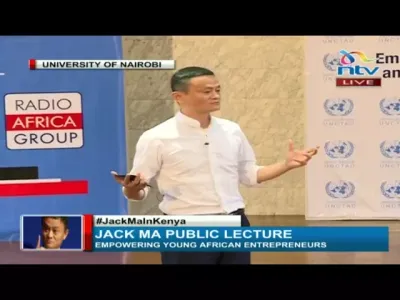
University of Nairobi Speech: The Internet is the Best Opportunity for Young People
On July 20, 2017, Jack Ma visited Africa for the first time and delivered a full English public speech at the University of Nairobi in Kenya. He recalled his journey from a teacher to an entrepreneur, emphasizing that his teaching experience taught him how to develop people and make employees better than himself, which is why he calls himself the 「Chief Education Officer」. He shared three elements of success: EQ, IQ, and LQ (quotient of love), and told stories of being rejected by over 30 jobs, KFC, and a hotel, encouraging young people to get used to failure and learn from it. He described Alibaba's growth from 18 people with 15,000 US dollars to 550 billion US dollars in annual transaction volume, and the story of the Taobao team buying and selling to themselves to test transactions. He believes the internet and e-commerce will empower small businesses and young people in Africa, and that weak infrastructure may instead become an opportunity for leapfrog development, urging Africa to use new technology to protect the environment and pursue a differentiated development path.

Tim Cook's MIT Commencement Address 2017
On June 9, 2017, Apple CEO Tim Cook addressed MIT graduates at Commencement. He recalled spending years searching for a purpose in school, work, and career advancement without finding a satisfying answer. Joining Apple under Steve Jobs finally gave him a mission: to serve humanity. Science and technology, he said, can improve health, education, and daily life, but may also bring threats to privacy and security, misinformation, and division. Drawing on his meeting with Pope Francis and Apple accessibility products, he urged graduates to bring humanistic values and empathy into technology. He closed by recounting how he defended environmental initiatives at a shareholders meeting and encouraged graduates to oppose injustice and use their minds, hands, and hearts to build something greater than themselves that serves everyone.
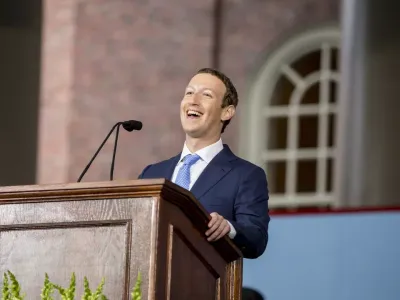
Mark Zuckerberg's 2017 Harvard Commencement Address
On May 25, 2017, Facebook founder Mark Zuckerberg addressed Harvard’s 366th Commencement. He reflected on leaving Harvard to build a social platform and placed his personal story in the context of technological change, economic inequality, and social division. He urged graduates to find purpose, help others gain opportunity, and accept responsibility for building community and improving the world, while emphasizing innovation, inclusion, and ideas such as universal basic income.
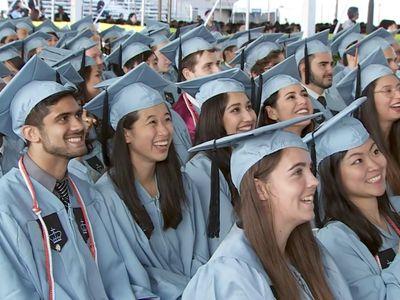
Kai-Fu Lee's 2017 Class Day Address at Columbia Engineering: An Engineer's Guide to the Artificial Intelligence Galaxy
On May 15, 2017, Columbia alumnus and Sinovation Ventures founder and CEO Kai-Fu Lee delivered the keynote address at the Engineering and Applied Science Class Day. Calling the coming decade the age of artificial intelligence, he explains how deep learning advances perception, prediction, decision-making, and automation, and predicts that finance, manufacturing, transportation, and other industries will be transformed while many repetitive jobs disappear. In response to the resulting growth in wealth, disruption of employment, and crisis of meaning, Lee offers graduates three pieces of advice: embrace the opportunities created by AI, accept engineers' responsibility for social consequences, and remain connected to the heart and to love. Drawing on his experience with stage IV lymphoma, he argues that brains and efficiency are not the whole of humanity; love, compassion, and care distinguish people from machines.
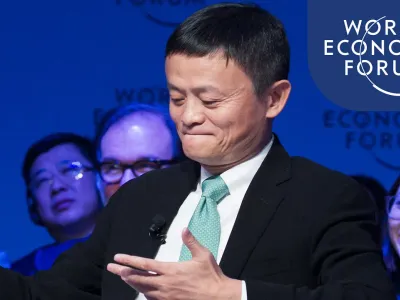
Davos 2017: An Insight, An Idea with Jack Ma
On January 18, 2017, Jack Ma was interviewed by New York Times columnist Andrew Ross Sorkin at the World Economic Forum in Davos, Switzerland. Against the backdrop of Trump's election and the rising tide of anti-globalization, he responded to questions about his meeting at Trump Tower and the promise of one million jobs, arguing that America's job losses stemmed from its own strategy — money flowing to wars and Wall Street instead of infrastructure and people's livelihoods — rather than being stolen by other countries. He advocated inclusive globalization and proposed eWTP to help SMEs trade across borders. On the difference with Amazon, he stressed that Alibaba does not build an empire but an ecosystem, supporting a $550 billion GMV by empowering logistics partners. He also described using big data to fight counterfeits, investing thousands of people and billions of RMB annually, and extending Sesame Credit to scenarios like renting and dating. He concluded by urging the world to focus on 30-year-olds and 30-person small businesses in the next 30 years.
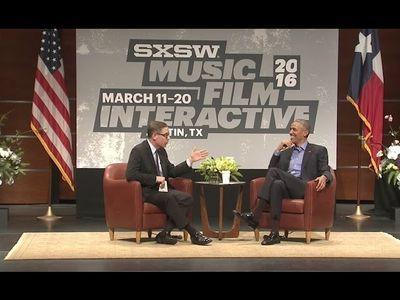
Remarks at South by Southwest Interactive
On March 11, 2016, President Barack Obama appeared at the South by Southwest (SXSW) Interactive festival in Austin, Texas, for a public conversation with Evan Smith, Editor-in-Chief of the Texas Tribune. This marked the first time a sitting U.S. president had spoken at SXSW. The conversation covered the intersection of technology and government, including the creation and work of the U.S. Digital Service (USDS), voting rights reform and online voter registration, the digital divide and educational equity, precision medicine and big data applications, and civic engagement. Obama also addressed the high-profile Apple vs. FBI encryption dispute, emphasizing the importance of finding a balance between privacy and security. The dialogue was delivered in a lighthearted and humorous style, showcasing Obama's thoughtful perspective on issues at the intersection of technology and society.
Making News for the New World
Financial Times editor Lionel Barber delivered this Polis public lecture at the London School of Economics and Political Science on November 12, 2015, shortly after Nikkei acquired the newspaper and as mobile devices, social platforms, and messaging applications were reshaping news distribution. Using the FT's metered paywall, engagement metrics, digital-first newsroom, and text-plus journalism as examples, Barber explains how trusted brands can balance reach and subscription return while technology platforms grow in power. He also addresses advertising, branded content, editorial independence, and complaints mechanisms. His central claim is that news organisations have a civic purpose but no automatic right to survive; their future depends on adaptability, curiosity, technical capability, and an uncompromising commitment to quality and innovation.
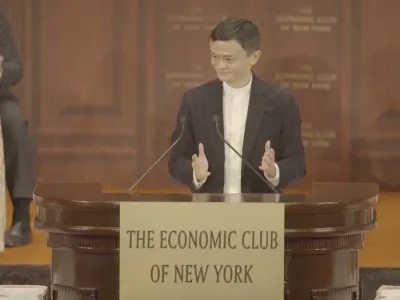
Jack Ma's Speech at the Economic Club of New York
On June 9, 2015, Jack Ma was invited to speak at the Economic Club of New York, addressing nearly a thousand U.S. business leaders about Alibaba's strategy in the United States. This was his second major address to mainstream American business circles after the 2014 IPO roadshow. He reviewed how he discovered the Internet in 1995 and founded Alibaba in 1999, explaining the fundamental difference between Alibaba and Amazon: Amazon is a shopping center that buys and sells itself, while Alibaba is a platform that helps small businesses buy and sell — a lifestyle. He described Alibaba's scale — 120 million daily buyers and $390 billion in annual sales — and announced a globalization strategy: helping American small businesses sell their products to China, and helping two billion global consumers shop online within ten years. He concluded by drawing an analogy to three technological revolutions, calling on nations to use the Internet and data to jointly fight disease, poverty and climate change.
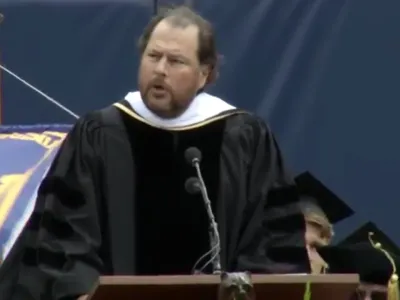
Marc Benioff's 2015 Commencement Address at UC Berkeley: Be a Platform for Change
On May 16, 2015, Salesforce founder and CEO Marc Benioff delivered the keynote address at UC Berkeley's campuswide commencement. He traced his path from programming video games and interning at Apple to working at Oracle and founding Salesforce, arguing that companies should do more than build and sell products: they can serve as platforms for social change. Benioff described Salesforce's 1-1-1 model, which committed one percent of equity, employee time, and product to philanthropy from the company's beginning. He also recounted business opposition to an Indiana law that threatened discrimination against LGBT people and Salesforce's review of gender pay equity, presenting civic engagement and equality as corporate responsibilities. He urged graduates to inherit Berkeley's traditions of disruption, equal rights, and service, and to use their knowledge, energy, values, and voices to improve the world.
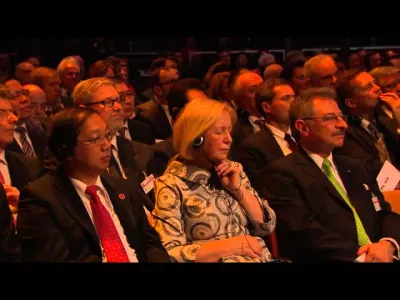
CeBIT 2015 Opening Keynote: The Missing Piece of the Internet Economy
On March 15, 2015, Jack Ma, as the only invited entrepreneur representative, delivered the keynote speech at the opening ceremony of the CeBIT (CeBIT) trade fair in Hannover, Germany. He recalled the difficulty of renting a small booth to sell Chinese products when he first came to Hannover 14 years ago, and the failure of trying to help exhibitors go online 8 years earlier. He pointed out that although the internet has been very successful over the past 20 years, few internet companies can live healthily and peacefully beyond 3 years, indicating that an important piece is missing from the industry. He believes this missing piece is the combination of the internet economy and the real economy — the collaboration between 「mouse and cement」 — and that the answer can be found in Europe. Ma described a future world driven by data: business will shift from B2C to C2B, machines will speak and think, enterprises will focus on flexibility, agility, and personalization, and women will have more leadership. He emphasized that it is not technology that changes the world, but the dreams behind technology, and his dream is to help small and medium enterprises.
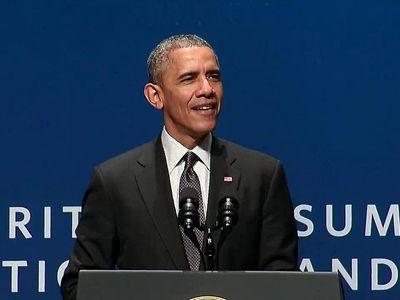
Cybersecurity and Consumer Protection Summit Address
On February 13, 2015, President Barack Obama delivered the Cybersecurity and Consumer Protection Summit Address at Stanford University. Addressing the growing cyber threat landscape, Obama outlined four core principles of America's cybersecurity strategy: shared mission, focused strengths, constant evolution, and privacy protection. He emphasized that government and the private sector must work hand in hand and share threat information. During the speech, Obama announced the creation of the Cyber Threat Intelligence Integration Center and signed an executive order to promote greater cyber threat information sharing between government and industry. He also proposed legislative initiatives including a Consumer Privacy Bill of Rights and the Student Digital Privacy Act. The speech concluded with Paul Baran's metaphor of technological development as building a cathedral, underscoring that innovation builds on generations of contributions, and calling for collective effort to shape a secure, open, and privacy-respecting digital future.
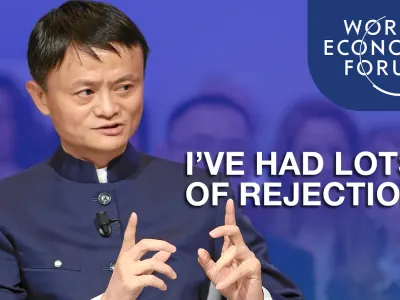
Davos 2015: An Insight, An Idea with Jack Ma
On January 23, 2015, Jack Ma was interviewed by CBS anchor Charlie Rose in the World Economic Forum session “An Insight, An Idea” in Davos, Switzerland. Returning after seven years, he recalled failing entrance examinations and being repeatedly rejected for jobs before founding Alibaba. He described spending nine years as a volunteer guide for foreign tourists in Hangzhou to learn English, encountering the internet in Seattle in 1995, and later building Alibaba's trust system. He explained how a Davos discussion about responsibility inspired the decision to launch Alipay, proposed using online trade to help small businesses reach global consumers, and discussed Hollywood, women at Alibaba, China's slower growth, wealth as a public trust, and the importance of learning from rejection rather than complaining.