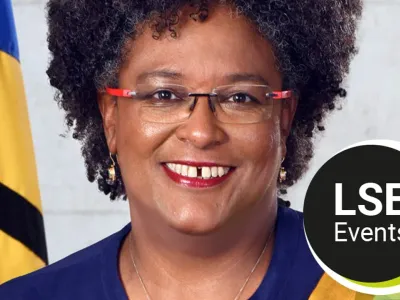
A Lecture by Mia Amor Mottley, Prime Minister of Barbados
Barbados Prime Minister Mia Amor Mottley delivered this lecture at her alma mater, the London School of Economics and Political Science, on December 6, 2023. Beginning with the destruction of families through the transatlantic slave trade, institutional racism, and the killing of George Floyd, she called for honest conversation, apology, redemption, and reparatory justice to repair souls, families, communities, and nations. Mottley connected wealth extracted through slavery and colonialism to today's climate crisis, debt burdens, and imbalances in global governance. She urged moral strategic leadership, development finance, and more representative international institutions in pursuit of fairness and collective action to save the planet.
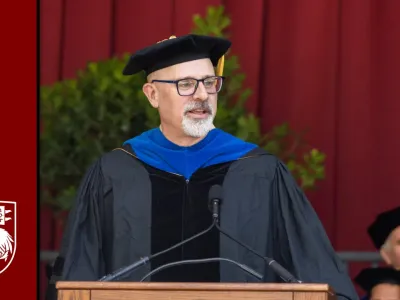
Tom Ginsburg's 2023 Convocation Address at the University of Chicago: Conversation and Democracy
On June 3, 2023, comparative constitutional scholar Tom Ginsburg delivered "Conversation and Democracy" at the University of Chicago's Convocation. Beginning with Francis Fukuyama's "end of history" thesis, he argued that democracy now faces pressure from authoritarianism, partisan polarization, and public disappointment, yet remains animated by hope rather than fear. Drawing on John Dewey, he stressed that legal rights cannot sustain democracy without free communication in daily life. Examples from South Africa's constitution-making, Shirley Chisholm's visit to George Wallace, and a Northern Ireland citizens' assembly showed how listening can bridge profound divisions. Universities, he said, should create better environments for dialogue and debate. Machines may imitate conversation, but they have no mind to change and no vote to cast; democratic progress requires people to keep talking, keep listening, and implement ideas formed with others.
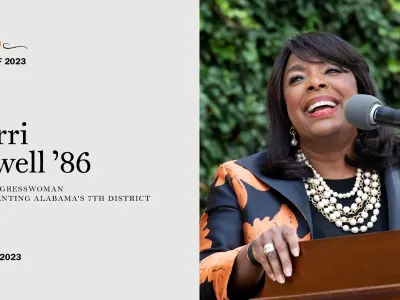
Terri Sewell's 2023 Class Day Address at Princeton University: Seeds of Service
On May 29, 2023, U.S. Representative Terri Sewell, a member of Princeton University's Class of 1986, returned to address the Class of 2023 on Class Day. She began with family stories about graduation and traced her journey from Selma, Alabama, to Princeton, the support she received from mentors, her legal career, and her return home to serve. She organized her remarks around three wishes: to bloom where planted, flourish where found, and spread seeds of service wherever graduates go. She argued that educational opportunity carries responsibility and encouraged a period of service through volunteering, community organizing, voting, or seeking local office. A closing story about a civil rights pioneer urged graduates to turn gratitude for earlier generations into action of their own.
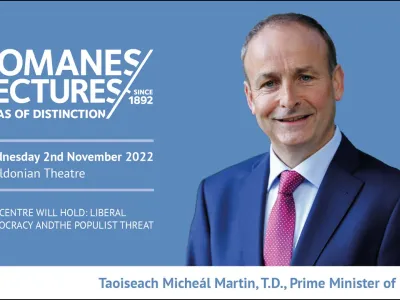
The Centre Will Hold: Liberal Democracy and the Populist Threat
On 2 November 2022, Taoiseach Micheál Martin delivered the Romanes Lecture at the University of Oxford. Taking Yeats's line that the centre cannot hold as his point of departure, he examined the threats that populism, authoritarian interference, online polarization, and the erosion of a shared public square pose to liberal democracy. Drawing on Ireland's democratic development, Europe's response to the pandemic and the war in Ukraine, the European Union's post-Brexit resilience, the Northern Ireland peace process, and refugee integration, Martin argued that democracy retains enduring strength. He called for an open form of nationalism, stronger defense of the rule of law and European cooperation, greater community contact and shared climate action, sustained investment in education and research, support for independent journalism, and the rebuilding of a public sphere capable of diverse, informed debate.
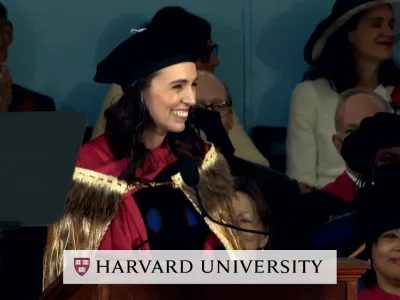
Jacinda Ardern's 2022 Harvard Commencement Address: Turning Kindness into Action
New Zealand Prime Minister Jacinda Ardern delivered this address at Harvard on May 26, 2022. Drawing on her experience as a young woman in leadership, she reflects on the Christchurch terrorist attack, the COVID-19 pandemic, and online polarization. Technology platforms have expanded expression and connection, she argues, but have also accelerated hatred, misinformation, and tribalism. Freedom of speech must therefore be protected alongside transparency, responsibility, and public trust. Ardern rejects the idea that empathy and kindness are forms of weakness. She calls on leaders to hold firm convictions while recognizing the humanity of others, to repair division through listening, facts, and collective action, and to treat kindness as a practical force for change.
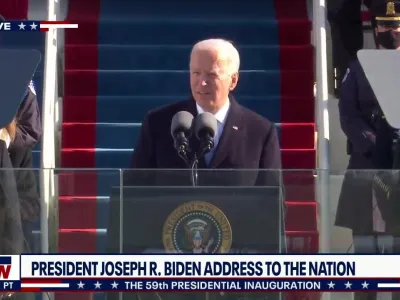
Joseph R. Biden Jr.'s 2021 Inaugural Address
On January 20, 2021, Joseph R. Biden was sworn in as the forty-sixth President of the United States at the Capitol building in Washington D.C. He had served as vice president under Barack Obama and is the oldest elected president in U.S. history (78 years old). This inauguration was one of the most unusual in American history: due to the COVID-19 pandemic, the number of attendees was significantly reduced, and it followed the January 6, 2021, Capitol riot. Biden's inaugural address centered on the theme of 'unity,' emphasizing healing national divisions, restoring democratic values, addressing the pandemic and climate change. He called on Americans to transcend differences and face challenges together. This inauguration also made history: Kamala Harris became the first woman vice president, and the first Black and Asian-American vice president in U.S. history.

Donald J. Trump's 2021 Farewell Address
On January 19, 2021, Donald J. Trump delivered his farewell address from the White House, marking his final public speech as the 45th President of the United States. This speech came after the January 6, 2021, Capitol riot. Trump reviewed the major achievements of his four-year term, including tax cuts, regulatory reform, energy independence, manufacturing reshoring, military rebuilding, and Middle East peace agreements. He emphasized the 'America First' policy philosophy and called for national unity. This was Trump's first acknowledgment of a peaceful transfer of power, though he still did not explicitly concede the 2020 election results. The farewell address was broadcast nationwide on television and online.

Maria Ressa's 2020 Commencement Address at Princeton University: Courage and Community
On May 31, 2020, journalist and Princeton Class of 1986 alumna Maria Ressa addressed graduates at the University's virtual Commencement. Beginning with her hope of returning to campus, she considered the possibility of rebuilding the world during the pandemic and discussed founding a news organization and responding to pressure. She offered three suggestions: choose to learn, face fear, and build supportive communities while avoiding mob hatred. She urged listeners to slow their judgments on social media, value mutual support, and work to realize the world they imagine. The text follows Princeton's official remarks published that day and preserves her contemporary account. Later Nobel Prize news links below the article are navigation and are excluded.
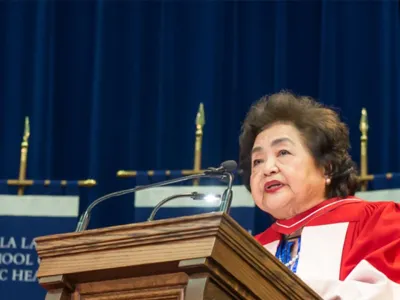
Setsuko Thurlow's 2019 Honorary Degree Address at University of Toronto: Unshakable Visionary Love
On June 5, 2019, Hiroshima atomic-bomb survivor, social worker, and nuclear-disarmament activist Setsuko Thurlow received an honorary degree from her alma mater, the University of Toronto. She recalled surviving the bombing as a teenager, choosing social work after witnessing mutual aid amid devastation, and how the hibakusha turned personal trauma into a responsibility to warn the world about nuclear weapons' inhumanity and immorality. She described U of T's teaching on the right to life, individual dignity, and practical fieldwork as the foundation of her activism. The address also traced the adoption of the Treaty on the Prohibition of Nuclear Weapons by 122 nations and the Nobel Peace Prize awarded to the International Campaign to Abolish Nuclear Weapons. She offered graduates four lessons: think beyond themselves, take action, persist and persevere, and trust unshakable visionary love as the power capable of overcoming the world's problems.
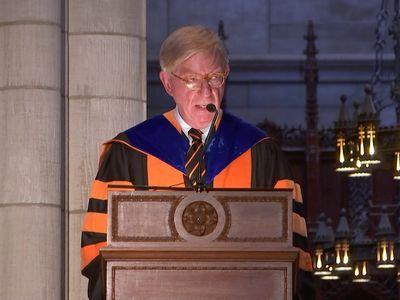
George Will's 2019 Baccalaureate Address at Princeton University: The Art of Praise
On June 2, 2019, George Will, the celebrated American political commentator, Pulitzer-winning columnist, and Princeton doctoral alumnus of 1968, delivered the University's Baccalaureate address. He opened with Polonius's maxim that brevity is the soul of wit, then recalled addressing 37 incarcerated men who had earned college degrees at Sing Sing prison — an experience that led him to warn against the 'infantilization of America' and what Senator Ben Sasse calls 'the vanishing American adult.' Arguing that social media fuels contempt and rage, Will insisted that a healthy adult culture requires learning to praise, recognize, and salute excellence. Drawing on Arthur Brooks's analysis of a 'culture of contempt' and the 'addiction to anger,' and on a baseball anecdote about three K signs and an umpire, he showed how recognizing excellence helps us make good judgments. He closed with the Princeton anthem's words 'rejoice in praise,' urging graduates to learn to praise and to become praiseworthy standards of excellence. The text follows Princeton University's complete official remarks published as prepared.
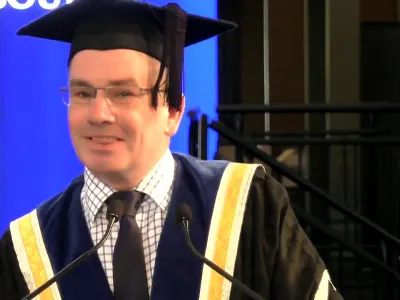
Adrian Little's 2018 Graduation Address at the University of Melbourne
On December 12, 2018, University of Melbourne political theorist and Pro Vice-Chancellor (International) Adrian Little delivered an occasional address to Arts graduates at the Royal Exhibition Building. Drawing on his upbringing during the Northern Ireland Troubles, undergraduate study in England, and doctoral work in Belfast, he described how sectarian division and limited international participation can narrow what universities teach and research. Little argued that internationalisation at Melbourne should mean more than recruiting overseas students: domestic and international students should learn from one another, diversity should shape curricula and staffing, and overseas subjects, internships, partnerships, and public programs should broaden every student's global experience. Calling graduates the University's most important ambassadors, he encouraged them to carry the Melbourne experience throughout the world while keeping the city close to their hearts.
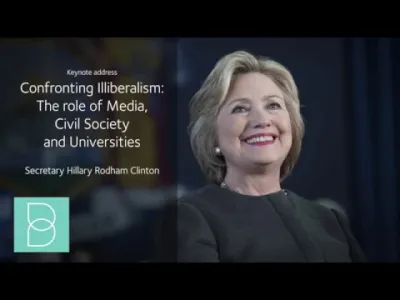
Hillary Rodham Clinton's 2018 Oxford Bonavero Institute of Human Rights Keynote Address
On 9 October 2018, Hillary Rodham Clinton delivered a keynote address at the University of Oxford's Bonavero Institute of Human Rights during a conference marking the seventieth anniversary of the Universal Declaration of Human Rights. Beginning with Eleanor Roosevelt's role in securing the Declaration, Clinton reviewed seven decades of institutional progress while warning that democratic backsliding, authoritarianism, economic inequality, xenophobia, and digital surveillance were creating new global threats. She proposed three priorities: democracies must support one another, defend the universality of human rights without ambiguity, and deliver materially better lives for their people. Clinton also argued that economic rights, digital rights, and individual control of personal data belong on the contemporary human-rights agenda. Drawing on the history of the Helsinki Accords to show how words can become facts, she called on governments, businesses, universities, the press, and citizens to defend freedom, dignity, and equality in the small places of everyday life.