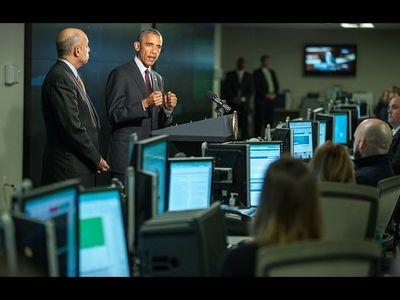
National Cybersecurity Communications Integration Center
On January 13, 2015, President Obama delivered a speech at the National Cybersecurity Communications Integration Center (NCCIC) in Arlington, Virginia. The address was a key part of the Obama administration's series of digital economy policy initiatives rolled out ahead of the State of the Union address. Against the backdrop of growing cyber threats — including the recent Sony Pictures hack and the breach of military social media accounts — Obama emphasized that cybersecurity is a core national security and economic security issue. He proposed three key initiatives: pushing Congress to pass cybersecurity legislation to promote information sharing between government and the private sector with liability protections; updating law enforcement authorities to more aggressively combat cybercrime; and hosting a White House Summit on Cybersecurity and Consumer Protection at Stanford University. The speech underscored the central role of public-private partnership in meeting the challenges of the digital age.
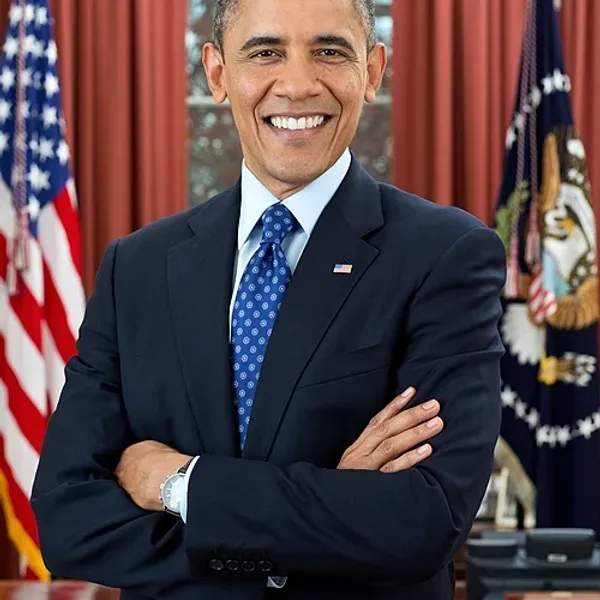
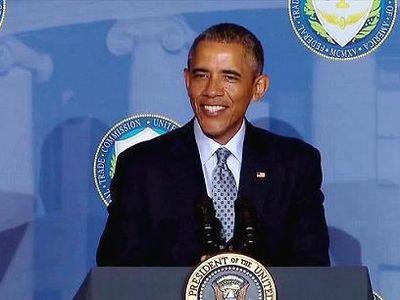
Federal Trade Commission Address
On January 12, 2015, President Barack Obama delivered an address at the Federal Trade Commission (FTC) at the Constitution Center in Washington, D.C. Marking the FTC's 100th anniversary, Obama became the first sitting president in nearly 80 years to visit the agency's headquarters. The speech focused on consumer protection and online privacy in the Information Age. Obama announced a series of new measures: a single national data breach notification standard, expanded free credit score access, a Consumer Privacy Bill of Rights, and a Student Digital Privacy Act to protect student data. This address was part of a series of policy proposals rolled out by the Obama administration ahead of the State of the Union, emphasizing the importance of protecting personal privacy and economic security in the digital economy and calling for bipartisan cooperation on cybersecurity challenges.
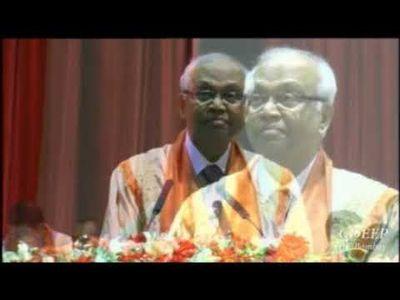
R. A. Mashelkar's 2014 Convocation Address at IIT Bombay: Affordable Excellence, a Global Game Changer
On August 9, 2014, Indian scientist R. A. Mashelkar addressed IIT Bombay's 52nd Convocation on the idea of affordable excellence. Making high technology for the rich or low technology for the poor is easy, he argued; the harder challenge is to make advanced technology serve ordinary people at prices they can afford. Through non-invasive hemoglobin testing, Aravind Eye Care, low-cost heart surgery, portable ultrasound, and electrocardiogram devices, Mashelkar described an Indian innovation model born from scarcity and aspiration: getting more from less for more people. He rejected low-price improvisation that neglects safety or quality and insisted that affordability brings equity while excellence brings competitiveness. Calling on graduates to apply IIT Bombay's mission of excellence and relevance to India's own problems, he urged them to create not merely value for money but value for many and to build a genuinely inclusive society.
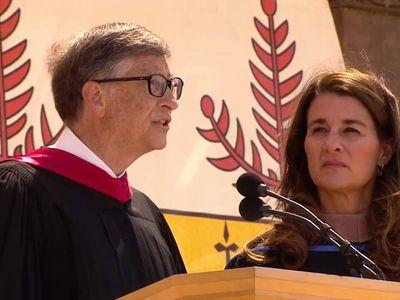
Bill and Melinda Gates' 2014 Stanford Commencement Address: Optimism and Empathy
On 2014-06-15, Bill and Melinda Gates delivered this address at Stanford University's Commencement. Organized around optimism, empathy, and turning toward suffering, it joins personal experience, professional judgment, and the public concerns of its moment. The address asks not only what graduates might do next, but also how educated people should understand their abilities, accept public responsibility, and help build a shared future. This edition is based on a complete authoritative transcript and preserves the sequence and character of the original address.
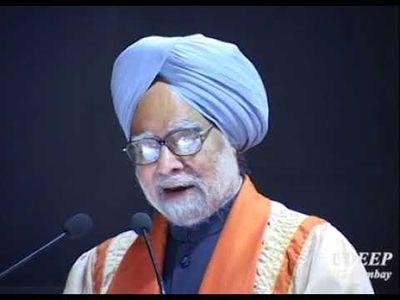
Manmohan Singh's 2012 Golden Jubilee Convocation Address at IIT Bombay
On August 18, 2012, Indian Prime Minister Manmohan Singh addressed IIT Bombay's 50th, or Golden Jubilee, Convocation. He recalled the post-independence vision of nation-building through great educational institutions and praised the IITs' role in creating Brand India. At the same time, he warned that too few excellent institutions, weakness in research and development, and curricula insufficiently connected to national needs continued to limit opportunity. Singh described public investment in expanding higher and technical education but argued that quantitative growth must produce qualitative improvement. Engineers and scientists, he said, should again become national leaders. Drawing on his own childhood study by kerosene lamp in a village without electricity or schools, he illustrated India's progress while acknowledging the distance still separating achievement from young people's expectations. Despite economic slowdown and pessimism, he expressed confidence that science, technology, education, and the rising generation could lead social and economic transformation, and urged graduates to remember the families, teachers, and society that made their education possible.
Salman Khan's 2012 MIT Commencement Address
MIT alumnus Salman Khan, founder of Khan Academy, delivered this address at the Institute's 146th Commencement on June 8, 2012. Beginning with MIT OpenCourseWare, he recounts how tutoring a cousin from a distance grew into a free educational platform serving learners around the world. Rather than offering a fixed formula for success, Khan asks graduates to value their limited time, pursue work that genuinely engages them, and avoid mistaking security for fulfillment. He encourages experimentation and the willingness to change course when an idea does not work, while protecting the roles of family, friendship, health, and continued learning in a meaningful life.
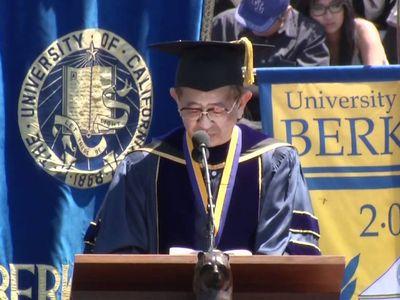
Eric Schmidt's 2012 Commencement Address at UC Berkeley: Find a Way to Say Yes to Things
On May 12, 2012, Google Executive Chairman Eric Schmidt, a 1982 Berkeley graduate, returned to his alma mater to deliver the keynote address at UC Berkeley's commencement. He opened by recalling the day he walked across the same stage in 1982, the year the computer was named Time magazine's Person of the Year, and the words from that article—that computers give us time for dreams. He praised Berkeley as a place committed to personal liberty and free expression, where humanism and science coexist, and reminded graduates that while no graduating class chooses the world it enters, theirs is the first fully connected generation in history and holds the greatest opportunities of the modern era. Connection, he said, is both an advantage and a responsibility, in a world still scarred by war, poverty and the absence of democracy. He urged graduates to find a way to say yes to things, never to fear failure or success, and not to let technology rule their lives, but to step away from their screens each day to love and truly live.

Martin Rees' 2011 Oxford Romanes Lecture: The Limits of Science
On 2 November 2011, British astrophysicist Martin Rees delivered the annual Romanes Lecture, The Limits of Science, at the Sheldonian Theatre, University of Oxford. Beginning with astronomy, he surveyed exoplanets, extraterrestrial life, the early universe, superstring theory, and the multiverse, then explained why complex systems cannot be usefully understood from fundamental physics alone and asked whether some aspects of reality may lie beyond human conceptual reach. The second half turned to nuclear weapons, population growth, pressure on resources, climate change, synthetic biology, artificial intelligence, and human enhancement. Rees argued that the gulf is widening between what science enables and what prudence, ethics, or economics should permit. Scientists, he concluded, must bring evidence into public debate, accept responsibility for the social consequences of their work, and help safeguard the Earth and future generations through values that lie beyond science itself.
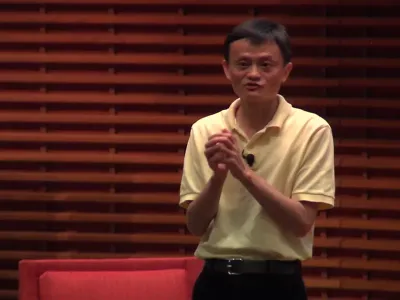
Alibaba's Ma Reflects On 12-Year Journey at China 2.0 Conference
Jack Ma delivered the closing keynote at Stanford's China 2.0 conference on September 30, 2011, and Stanford Graduate School of Business published the full recording on October 6. He reviewed Alibaba's twelve-year journey and discussed B2B, Taobao, Alipay, AliCloud, small businesses, credit systems, and corporate responsibility. Roughly thirty-five minutes of questions followed, covering a possible Yahoo acquisition, VIE regulation, lessons from Yahoo China, Taobao's structure and logistics, the Alipay dispute, international access, foreign companies in China, U.S.-China misunderstandings, and globalization. This edited transcript follows the publisher-provided English captions, preserves all speakers and question order, removes nonverbal markers and empty disfluencies, and corrects clear contextual errors in names, figures, and technical terms.
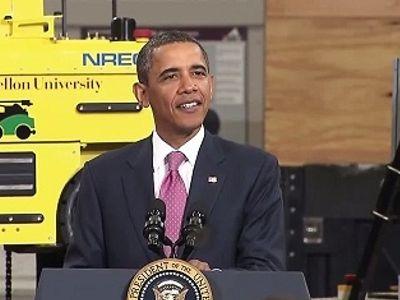
Address at the National Robotics Engineering Center
On June 24, 2011, President Barack Obama spoke at Carnegie Mellon University's National Robotics Engineering Center in Pittsburgh, Pennsylvania, while the United States was still recovering from the financial crisis. With manufacturing employment, industrial competitiveness, and middle-class wages at the center of public debate, he pointed to Pittsburgh's transformation from a steel city into an innovation hub. Obama presented the Advanced Manufacturing Partnership, the Materials Genome Initiative, next-generation robotics research, and collaboration among government, universities, and industry as ways to move ideas from laboratories to factories and markets more quickly. He argued that manufacturing renewal was not only about frontier technologies such as robotics, but also about workers' skills, business competitiveness, and America's long-term economic leadership.
Speech on the National Wireless Initiative
On February 10, 2011, President Barack Obama delivered a speech at Northern Michigan University in Marquette, Michigan, announcing the National Wireless Initiative. At the time, America's broadband coverage lagged behind countries like South Korea, with only 65% of households having access to high-speed internet. Obama proposed extending high-speed wireless service to 98% of Americans within five years, funded by selling wireless spectrum rights to reduce the deficit. Using Northern Michigan University's wireless network as an example, he illustrated how broadband access drives education, healthcare, and economic growth, while drawing parallels to America's historical infrastructure achievements including the transcontinental railroad, rural electrification, and the Interstate Highway System.
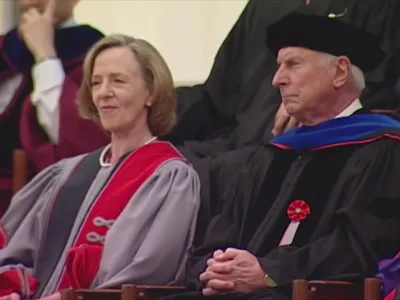
Raymond S. Stata's 2010 MIT Commencement Address
Analog Devices co-founder and MIT alumnus Raymond S. Stata delivered this address at the Institute's Commencement on June 4, 2010. Drawing on his entrepreneurial career, he offers principles for innovation, organizations, and personal choice: pursue technical leadership, respect the people who create value, give talented employees autonomy, and build trust through honesty, integrity, reliability, and competence. Stata discusses lessons from a failed corporate venture fund, tells graduates not to fear mistakes, and warns that working smarter cannot substitute for working harder. Amid financial crisis and global transition, he urges them to enter the unknown courageously, remain passionate, give back, and apply technology to energy, sustainability, poverty, and disease.