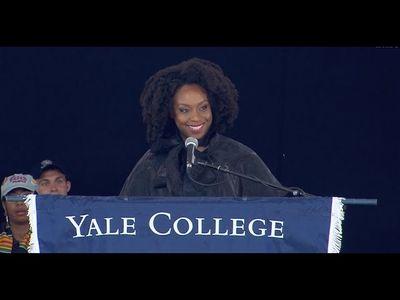
Things Are Not Standing Well
On May 19, 2019, Nigerian author Chimamanda Ngozi Adichie delivered the Class Day address at Yale University. Recalling her graduate years at Yale a decade earlier, she joked about eavesdropping to gather material for her fiction. Addressing graduates about to enter the world, she urged them to accept contradiction and uncertainty, to be open to changing their minds, and to balance idealism with pragmatism. Borrowing the Igbo expression 'things are not standing well,' she asked what America should become and warned against the self-righteous sneer, urging reliance on primary sources. She closed by calling for friendship, honest apology, and never admiring quietly. The text is based on YouTube auto-generated captions.
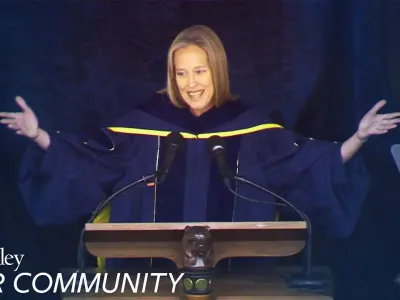
Wendy Kopp's 2019 Commencement Address at UC Berkeley: Lead Us Forward Differently
On May 18, 2019, Wendy Kopp addressed the UC Berkeley Class of 2019 at Spring Commencement. She is the founder of Teach For America and CEO and co-founder of Teach For All. She praised the class for its extraordinary strengths and perspective, then reflected on her own thirty-year journey, from a senior thesis that became Teach For America to a global network of similar organizations in more than fifty countries. Individual, heroic leadership is no longer enough, she argued; what we need is "collective leadership," in which diverse people trust one another, listen, and work together to co-create a shared vision. Drawing on education reform in Haiti and the Oakland school system, she stressed that dialogue and openness are the only path to a just and sustainable future, and urged graduates to replace judgment with curiosity and lead differently.
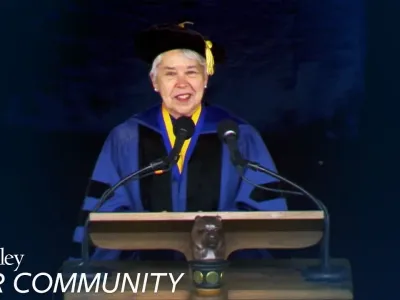
Carol T. Christ's 2019 Commencement Address at UC Berkeley: You Must Not Abandon Civic Life
On May 18, 2019, Carol T. Christ, the 11th chancellor of the University of California, Berkeley, delivered the commencement address under rainy skies. She first looked back at the history this class had lived through: the stunning defeat of the strongest woman presidential candidate the U.S. has ever known, the longest government shutdown in the country's history, the rise of 'alternative facts' and 'post-truth' as the word of the year, the Black Lives Matter and #MeToo movements, and a wave of natural and man-made disasters. She recounted what the students had done on campus—pressing for reform of sexual assault procedures, defending undocumented students, advocating for 100 percent clean energy, and founding the Basic Needs Center. Noting that the wider world holds even more intractable problems, she urged them never to abandon civic life and a commitment to the public good, and closed by quoting Robert Kennedy's 1966 speech at the Greek Theater.
We Are International
On 13 March 2019, Imperial College London President Alice Gast delivered her annual address, We Are International, amid political turmoil over Brexit. Beginning with her own formative travels in Europe, she used the idea of hybrid vigour to explain how cultural differences strengthen research and described international teams in public health, bionic prosthetics, regenerative medicine, and green technology. The speech then traced immigration's contribution to British history, entrepreneurship, and innovation, and presented academics as diplomats capable of crossing political divides. Gast proposed visa reform, wider post-study work rights, and stronger support for international research collaboration, reaffirming Imperial's commitment to global talent and internationalist values.
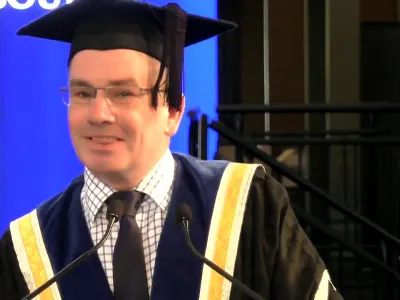
Adrian Little's 2018 Graduation Address at the University of Melbourne
On December 12, 2018, University of Melbourne political theorist and Pro Vice-Chancellor (International) Adrian Little delivered an occasional address to Arts graduates at the Royal Exhibition Building. Drawing on his upbringing during the Northern Ireland Troubles, undergraduate study in England, and doctoral work in Belfast, he described how sectarian division and limited international participation can narrow what universities teach and research. Little argued that internationalisation at Melbourne should mean more than recruiting overseas students: domestic and international students should learn from one another, diversity should shape curricula and staffing, and overseas subjects, internships, partnerships, and public programs should broaden every student's global experience. Calling graduates the University's most important ambassadors, he encouraged them to carry the Melbourne experience throughout the world while keeping the city close to their hearts.
Let's Talk About Race: The Inequality Universities Must Confront
On 17 October 2018, University of Cambridge Vice-Chancellor Stephen J. Toope delivered the closing remarks at a “Let's Talk About Race” event. Beginning with a Black American postgraduate student's account of feeling unusually uncomfortable at Cambridge, he described the isolation, stereotyping, microaggressions, and lack of representation experienced by minority students and staff. Toope acknowledged that Cambridge was not a leader on racial equality. Discrimination, he argued, was morally and ethically wrong and also deprived the University of talent, experience, and opportunities to widen its outlook. He called on the whole institution, not only those most affected, to challenge racism, diversify curricula and leadership, and support measures including scholarships, staff networks, and anti-harassment contacts. More visible stories of Black scholars and students, he concluded, should help every talented person see Cambridge as a place for them.
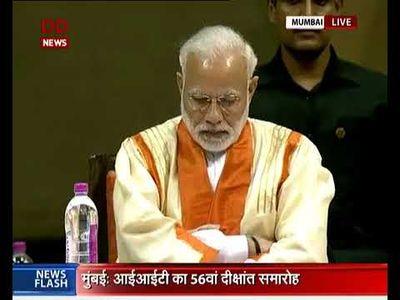
Narendra Modi's 2018 Convocation Address at IIT Bombay
On August 11, 2018, Indian Prime Minister Narendra Modi delivered the convocation address at IIT Bombay's 56th annual graduation ceremony during the Institute's diamond-jubilee year. Beginning with revolutionary Khudiram Bose's sacrifice, Modi framed service to a free India and nation-building as the responsibility of the present generation. He reviewed the IITs' role in expanding engineering education, creating India's information-technology sector, and building Brand India globally. Looking toward 5G, artificial intelligence, blockchain, big data, machine learning, clean energy, and environmental challenges, he recast IIT as an 'Instrument of Transformation' and urged graduates to 'Innovate in India, Innovate for humanity.' Modi described public programs supporting start-ups, research fellowships, and educational infrastructure while arguing that engineering education must improve quality and skills as well as quantity. He also proposed city-based science clusters, stronger alumni participation, mentoring for students who lack opportunity, and school outreach. A degree, he concluded, is only a milestone; the real challenge lies beyond campus, where graduates' work carries the hopes of their families, the country, and future generations.
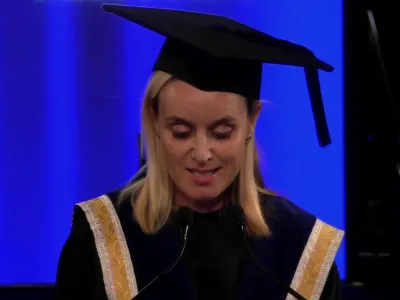
Clare Payne's 2018 Graduation Address at the University of Melbourne: Endurance
On July 28, 2018, Australian ethics writer, lawyer, and marathon swimmer Clare Payne delivered a University of Melbourne occasional address titled “Endurance.” Drawing on Shackleton's expedition, vaccine development, and extreme survival stories, she argued that meaningful progress is rarely an overnight success and instead requires persistence through failure, criticism, and delay. Payne connected that theme to her own 20-kilometre Rottnest Channel crossing, a 46-kilometre swim around New York, and professional efforts to establish a banking oath and promote tobacco-free investment. Endurance, she said, grows through planning, training, patience, acceptance, and continued action. She urged graduates not to measure success by wealth but to think long-term, create lasting change, and use their education to build a better and fairer world.
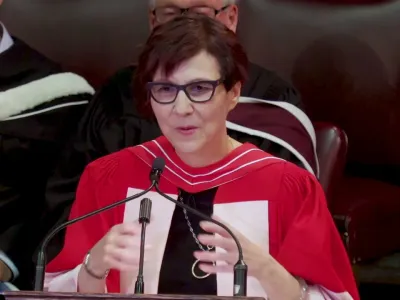
Cindy Blackstock's 2018 Honorary Degree Address at University of Toronto: Love and Moral Courage
On June 19, 2018, First Nations children's-rights advocate Cindy Blackstock delivered an honorary-degree address at the University of Toronto. Framing love and moral courage as the means to confront hate, she urged graduates to speak and act when told to remain silent or become bystanders, drawing on Shannen Koostachin, Jordan River Anderson, and other children as examples of continuing inequality. The address centers on U of T alumnus and public-health pioneer Peter Henderson Bryce, who documented catastrophic mortality among Indigenous children in residential schools and was punished for challenging government inaction, in contrast with residential-school administrator Duncan Campbell Scott, who received public honours. Recounting a later human-rights victory and Bryce's restored recognition, Blackstock argued that doing right may not be rewarded immediately, moral cowardice should never be honoured, and graduates must carry the love of family and ancestors into courageous public action.
The Value of a College Degree
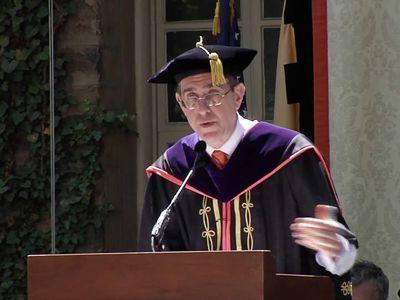
On June 5, 2018, Christopher L. Eisgruber, President of Princeton University, delivered the commencement address 'The Value of a College Degree.' Against the popular claim that there are too many college graduates, he cited research by Federal Reserve Bank of New York economists showing an annual return of 9 to 16 percent on a college degree — far exceeding stock-market returns — along with added benefits to health, happiness, and civic engagement. He offered three suggestions: advocate for higher completion rates, support public institutions of higher education, and help more low-income students earn degrees. Emphasizing that a college education is a long-term rather than short-term investment, he called the call for 'fewer degrees' a short-term swindle and insisted the world needs more, not fewer, college graduates. The text follows Princeton University's complete official remarks published as prepared.
Drew Gilpin Faust's 2018 Harvard Commencement Address
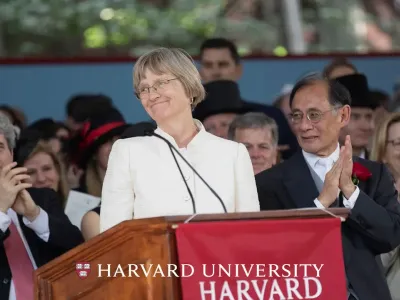
On May 24, 2018, outgoing Harvard president Drew Gilpin Faust delivered a valedictory Commencement address. Looking back on eleven years marked by financial crisis, the Boston Marathon bombing, public-health threats, climate change, student activism, and political polarization, she argued that hope is not merely the innocence of inexperience but a conviction formed through the daily work of a university. She described universities as beacons of hope and living laboratories, emphasizing education, research, diversity, free speech, facts, evidence, and reasoned debate. She concluded that hope points to unfinished work and therefore presents a challenge.
Hillary Clinton's 2018 Class Day Address at Yale University: Resilience, Empathy, and Democracy
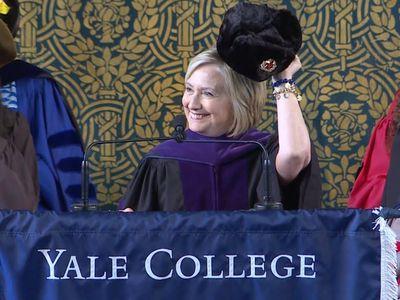
On May 20, 2018, Hillary Rodham Clinton, a 1973 graduate of Yale Law School and former U.S. Secretary of State, delivered the Class Day address at Yale University. A member of the first class of women admitted to Yale College, she recalled arriving on campus in 1969 in bell-bottoms, meeting Bill Clinton in the law library, and finding her calling through civil rights pioneer Marian Wright Edelman. Framing her remarks around resilience, she distinguished personal, communal, and democratic resilience, warned against polarization and the assault on facts and reason, and urged graduates to practice radical empathy, vote in every election, and stand up for democracy. The text is reconstructed from YouTube auto-generated captions.